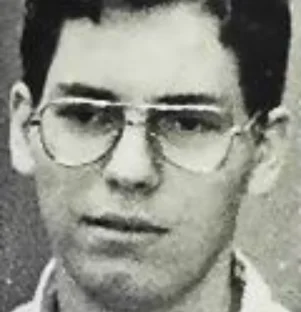
Summary
Name:
Wyley GatesYears Active:
1986Status:
ReleasedClass:
MurdererVictims:
4Method:
ShootingNationality:
USASummary: Murderer
Name:
Wyley GatesStatus:
ReleasedVictims:
4Method:
ShootingNationality:
USAYears Active:
1986Date Convicted:
October 6, 1987"If I did it again they would never catch me. I know how to totally get away with it."
— Wyley Gates
Wyley Gates was born in 1969 and grew up in Canaan, in Columbia County, New York, in a rural log cabin home with his father, Robert Gates Sr., a businessman. A brilliant student, Wyley was known as a computer enthusiast in an era when this made him an outsider among peers who favored cars and sports; he reportedly endured teasing from his father over this interest. He would go on to graduate second in his class — salutatorian — at Chatham High School in June 1987, while awaiting trial in county jail.
On December 4, 1986, a burglary was reported at the Gates family home; among the items reported stolen were firearms, ammunition, and various valuables. School records later showed that both Wyley Gates and his close friend, Damian Rossney, were away from school that exact day — Gates excused, Rossney marked absent — a coincidence investigators would later view as strong evidence the "burglary" had actually been staged by the two of them to obtain a weapon in advance.
Nine days later, on the night of December 13, 1986, Robert Gates Sr., 39; his older son, Robert "Bobby" Gates Jr., 19; his live-in girlfriend, Cheryl Brahm, 36; and Wyley's three-year-old cousin, Jason Gates, were all found shot to death inside the family home. All four had been killed with a .380 Walther PPK pistol — the same type of weapon reported stolen in the December 4 burglary. Around 11 p.m. that night, Wyley's paternal grandmother, Vivian Gates, called the Columbia County Sheriff's Office, telling authorities that her grandson had told her the family members had been found shot to death in the home.
Wyley Gates was taken into custody the following day. During police questioning, he gave a confession — later a central point of legal dispute — in which he described knowing exactly where the bodies were located and recounted details including the murder weapon jamming during the shootings; he reportedly told police he shot the additional victims because they "got in the way." His defense later argued this confession had been obtained in violation of his constitutional rights, contending police had kept his first assigned attorney out of the interrogation room, and that the interrogating officer never recorded their conversations, relying instead on a written summary he prepared afterward.
Prosecutors, led by Columbia County District Attorney Eugene Keeler, argued Wyley had plotted the murders out of hatred for his father and brother and a desire to collect a $100,000 inheritance. The defense, led by attorney Wilcox, argued Wyley was psychotic and out of touch with reality at the time, and that he had confessed and taken responsibility largely to protect the actual killer — his friend Damian Rossney — out of a sense of honor and loyalty.
The trial lasted approximately ten weeks. On October 6, 1987, following 42 hours of jury deliberation spread across six days, Wyley Gates was acquitted of all four counts of second-degree murder and of criminal possession of a weapon — a verdict that drew significant community outrage — but was convicted of second-degree conspiracy for planning the killings. On November 9, 1987, Columbia County Judge John G. Leaman sentenced Gates, then 18, to the maximum term of 8⅓ to 25 years in prison, stating, "It was his hatred for his father that gave birth to this conspiracy." Leaman noted that although psychiatric experts on both sides agreed something was psychologically wrong with Gates, the jury had not found him legally insane, and he had to be held accountable. Asked if he had anything to say before sentencing, Gates said only, "No, sir."
Damian Rossney was tried separately and convicted of second-degree conspiracy and criminal facilitation, based on evidence that he had helped plan the murders and hidden the murder weapon afterward; he received the same 8⅓-to-25-year sentence and served it at Woodbourne Correctional Facility in Sullivan County. Years later, in a chance conversation while being transported to prison after sentencing, a former undersheriff asked Wyley Gates why he had done it; Gates reportedly replied, "If I did it again they would never catch me. I know how to totally get away with it."
Gates became eligible for parole in 1995 but was repeatedly denied, including after failing to appear for at least two scheduled parole hearings; one parole board notice to him stated, "Your indifference to human life demonstrates that you present a serious threat to community safety and welfare. Release would also deprecate the seriousness of your offense." After serving nearly 17 years, Wyley Gates was released from Collins Correctional Facility in Erie County on August 12, 2003, at age 34, walking out with a college degree earned during his incarceration and a pre-arranged job as a clerk at a New York City law firm. He remained under parole supervision for approximately eight years following his release. Damian Rossney was later also released on parole, remaining under supervision until the end of his original sentence in 2013.
