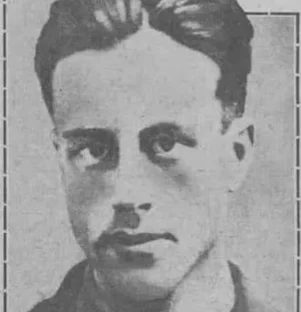
d: 1933
Summary
Name:
Stanley Eric HobdayYears Active:
1933Status:
ExecutedClass:
MurdererVictims:
1Method:
StabbingDeath:
December 28, 1933Nationality:
United Kingdomd: 1933
Summary: Murderer
Name:
Stanley Eric HobdayStatus:
ExecutedVictims:
1Method:
StabbingNationality:
United KingdomDeath:
December 28, 1933Years Active:
1933Stanley Eric Hobday was born in 1912 and worked as an electrician in West Bromwich, in what is now the West Midlands of England. He was known to local police as a petty thief prior to the events of August 1933. Contemporary accounts describe him as notably short in stature — reports of his exact height vary — and he was known to police prior to the murder for minor offenses.
In the early hours of Sunday, August 27, 1933, Gladys Fox was woken by the sound of breaking glass at her home at 8 Moor Street, West Bromwich. She alerted her husband, 24-year-old Charles William Fox, who went downstairs to investigate. He entered the sitting room and emerged moments later with a knife in his back; he died in his wife's arms shortly afterward, having been stabbed seven times. Fourteen shillings were stolen from the home.
Investigating officers soon discovered that the same night had also seen a break-in at a nearby butcher's shop on Bromford Lane, owned by Robert Arthur Newton. Several pounds had been taken from the till, but the burglar left behind a number of distinctive traces: a bowl of soapy water and Newton's razor, apparently used to shave; a sewing basket that had been used, with needle and thread left out; and an emptied milk bottle covered in fingerprints.
Chief Inspector Fred Cherrill of Scotland Yard, one of the leading fingerprint experts of the period, was able to identify Hobday as the source of the fingerprints within a short time. The case became notable as the first in which the BBC used its radio network to broadcast a description of a wanted man on behalf of police.
By this time, Hobday had already fled north from Birmingham in a stolen Jowett motorcar, taken from near the scene of the butcher's shop burglary. Near High Leigh in Cheshire, a labourer working in a field was startled to see the car go airborne, flip completely, and land back on its wheels; Hobday emerged dazed but unhurt and walked away, leaving behind his suitcase and fingerprints on the vehicle's starting handle.
Continuing on foot, Hobday got as far as the area near Carlisle before he encountered a cowman moving a herd of cattle for milking along the road. The cowman believed he recognized Hobday from the police radio broadcast he had heard, and alerted police. A short time later, Hobday was confronted by a police constable of the Cumberland Constabulary and went with him without resistance.
At his trial at Stafford Assizes in November 1933, the evidence against Hobday was considered overwhelming; witnesses included a boy who testified to having seen Hobday in possession of a knife similar to the murder weapon, and shoeprints found outside the Fox home were matched to a distinctive small shoe size associated with Hobday. The jury took only around 45 minutes to convict him. The trial judge, Mr. Justice Talbot, described the killing as "a cruel and brutal murder." An appeal against the conviction was dismissed by the Lord Chief Justice.
Stanley Eric Hobday was executed by hanging at Winson Green Prison in Birmingham on December 28, 1933, at 8:00 a.m. The execution was carried out by Thomas Pierrepoint, assisted by his nephew, Albert Pierrepoint.
