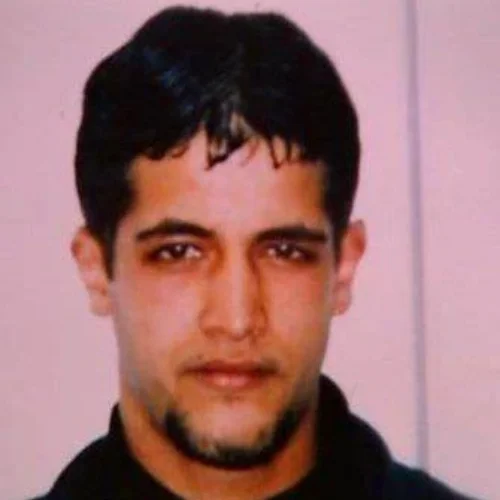
1979 - 2000
Summary
Name:
Sid Ahmed RezalaNickname:
The Train KillerYears Active:
1999Birth:
May 13, 1979Status:
DeceasedClass:
Mass MurdererVictims:
3Method:
Strangulation / Stabbing / Pushing from trainDeath:
June 28, 2000Nationality:
Algeria1979 - 2000
Summary: Mass Murderer
Name:
Sid Ahmed RezalaNickname:
The Train KillerStatus:
DeceasedVictims:
3Method:
Strangulation / Stabbing / Pushing from trainNationality:
AlgeriaBirth:
May 13, 1979Death:
June 28, 2000Years Active:
1999“There’s a flash… you see her dead.”
— Sid Ahmed Rezala
Sid Ahmed Rezala was born on May 13, 1979, in El Bar, Algeria. He lived there with his family until he was 15 years old. In 1994, Rezala and his family moved to Marseille, France, seeking better opportunities. His father worked as a mechanic. In Algeria, Rezala had done well in school, but things changed when they moved to France.
After relocating to Marseille, Rezala began to have trouble at school. He started associating with the wrong crowd, including drug dealers and petty criminals. By the age of 15, he was showing signs of delinquency. His early behavior included petty theft, and he began to develop a criminal record.
In 1995, at the age of 16, he was convicted for a crime involving violence. He had also committed a serious sexual assault on a 14-year-old boy. Despite his troubles with the law, Rezala found work as an apprentice baker when he was not in prison. He was described as charming and made friends easily.
In 1997, he met his girlfriend, Nadia Abdelmalek, who had his daughter a year later. However, he faced setbacks due to further legal issues. In the same year, he was sentenced to a young offenders institution for threatening a railway worker with a knife.
Following his release, Rezala experienced rejection when Nadia informed him that she was moving on with another man. This incident reportedly affected him deeply. After this rejection, he is believed to have roamed France, and his life began to spiral out of control.
Rezala was known to have a history of psychiatric illnesses and unstable behavior. His long history with the legal system included multiple convictions for violent crimes and sexual offenses.
Sid Ahmed Rezala was a suspect in the murders of three women in France between October and December 1999. The first victim was Isabel Peake, a 20-year-old British exchange student. Her body was found beside a railway line in central France on October 13, 1999. She had been traveling on an overnight train from Limoges to Paris. Witnesses reported seeing a man matching Rezala's description interacting with her before her death.
The second victim was Corinne Caillaux, a 36-year-old French woman who was murdered on December 13, 1999. She was found stabbed multiple times in a train toilet while her young son slept in a nearby compartment. Police linked Rezala to her death after he had been seen on the same train.
The third victim was Emilie Bazin, a 20-year-old sociology student. Her body was discovered on December 18, 1999, buried under coal in a cellar of a building in Amiens, where Rezala had been living. She had been reported missing earlier that year.
After a prolonged search, Rezala was arrested in Lisbon, Portugal, on January 11, 2000. He had managed to evade French authorities and had slipped across the border to Spain, where he was briefly arrested for theft, but was released due to a lack of an international warrant at that time.
While in Portugal, Rezala attempted suicide in March by slashing his arm and neck but was treated and survived. His extradition to France was delayed due to legal proceedings. During this time, he gave a controversial interview in which he confessed to the murders, describing how he experienced sudden "flashes" compelling him to kill. He noted that he had approached Peake at a train station, lent her his mobile phone, and then moments later, he felt the urge to attack her.
On June 28, 2000, while waiting for extradition in a Portuguese prison, Rezala committed suicide. He set fire to his mattress, causing smoke that led to his death by asphyxiation. His death sparked outrage and criticism of both the French and Portuguese justice systems for allowing him to avoid a trial.
