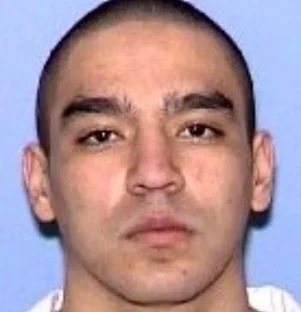
1982 - 2013
Summary
Name:
Robert Gene GarzaNickname:
BonesYears Active:
2002Birth:
May 15, 1982Status:
ExecutedClass:
Mass MurdererVictims:
4Method:
ShootingDeath:
September 19, 2013Nationality:
USA1982 - 2013
Summary: Mass Murderer
Name:
Robert Gene GarzaNickname:
BonesStatus:
ExecutedVictims:
4Method:
ShootingNationality:
USABirth:
May 15, 1982Death:
September 19, 2013Years Active:
2002Date Convicted:
December 11, 2003"I know it's hard for you. It's not easy. This is a release. Y'all finally get to move on with your lives."
— Robert Gene Garza
Robert Gene Garza, known as "Bones," was born on May 15, 1982, in Hidalgo County, Texas, and worked as a laborer. He became a member of the Tri-City Bombers, a Rio Grande Valley gang, before he was even a teenager. In February 1997, he was sent to the Hidalgo County Youth Village, a residential facility for boys; later that year, he was placed in the custody of the Texas Youth Commission for burglary of a habitation. In February 2002, he was sent to the Texas Department of Correction for escape.
Around midnight on September 4, 2002, Maria De La Luz Bazaldua Cobarrubias finished her shift as a barmaid at Garcia's Bar in Donna, Texas, and offered to drive five coworkers — Danitzene Lizeth Vasquez Beltran, Celina Linares Sanchez, Lourdes Yesenia Araujo Torres, Karla Espino Ramos, and Magda Torres Vasquez — home to the mobile home where they all lived. A sixth coworker, Nora Rodriguez, stayed behind to close the bar. Unbeknownst to Cobarrubias, a vehicle followed them the entire way to their home on Valley View Road.
After Cobarrubias parked near their trailer, gunfire erupted. Witnesses saw two men dressed in black repeatedly firing into the vehicle; police later recovered 61 spent shell casings from the scene. All but one of the women in the car were shot; four of them, Cobarrubias, Beltran, Sanchez, and Torres, died. After riddling the car with bullets, the gunmen got into the vehicle that had followed the women and sped away, later abandoning it a few miles away after it ran out of gas.
The investigation eventually revealed that the killings were a case of mistaken identity. The actual target of the hit was Nora Rodriguez, the coworker who had stayed behind at the bar that night, a leader of the Tri-City Bombers, who was serving time for attempted murder, had ordered her killed because she had witnessed a shooting at Garcia's Bar and later testified against him. The gunmen sent to kill Rodriguez instead attacked the wrong car and killed the other women by mistake.
Informants pointed police toward Garza, whose tattoos attested to his gang affiliation, as a possible gunman; police also suspected him of involvement in a separate, unrelated mass killing that occurred four months later, in January 2003, in nearby Edinburg, Texas a case that became known as the "Edinburg massacre," in which gang members staged a fake police raid on two houses in a botched attempt to steal drugs, killing six people. Garza was arrested on January 24, 2003, and was first questioned about the Edinburg case, which he confessed to.
Two days later, on January 26, an officer with the Hidalgo County Sheriff's Office questioned him specifically about the Donna killings. Garza gave a written statement admitting he helped prepare for the murders and followed the gunmen's car to the trailer, but he denied being one of the shooters himself. He wrote that he and another gang member "received instruction[s] to carry out a hit that resulted in the death of four [women]. The hit was organized for us."
After obtaining vehicles and a gun, Garza said he followed another car to the crime scene, watched two fellow gang members get out, and "then shots rang out." Both vehicles fled until the one Garza was riding in broke down. He wrote that the gang leader who had ordered the hit "was mad 'cause it wasn't done right", an acknowledgment that the wrong victims had been killed. Garza was also separately implicated as a suspect in the Edinburg massacre, though he was charged but never tried for that case.
A Hidalgo County grand jury indicted Garza in September 2002 for the murders of Cobarrubias, Beltran, Sanchez, and Torres. A jury found him guilty of capital murder, convicting him under Texas's law of parties, which holds non-triggerman participants equally responsible for a crime. Prosecutors argued Garza was a gang leader who directed how the killings should be carried out, was present when the shootings took place, and, in the words of Hidalgo County Assistant District Attorney Joseph Orendain, was "in all likelihood was a shooter but is downplaying his part." The jury recommended a death sentence, and judgment was entered on December 17, 2003. During the trial's punishment phase, jurors also heard about an April 2003 attempted escape from the Hidalgo County Jail while Garza awaited trial.
The Texas Court of Criminal Appeals rejected Garza's direct appeal and affirmed his conviction and sentence in 2007; he did not appeal that decision to the U.S. Supreme Court. His state habeas corpus application was denied by the Texas Court of Criminal Appeals on September 10, 2008. His subsequent federal habeas corpus petition was denied by the U.S. District Court for the Southern District of Texas on September 15, 2011, and the Fifth Circuit Court of Appeals denied his request for a certificate of appealability on August 27, 2012. The U.S. Supreme Court denied his final petition for certiorari on February 19, 2013.
Robert Gene Garza was executed by lethal injection at the Huntsville Unit in Huntsville, Texas, on September 19, 2013, becoming the 12th person executed in Texas that year. He smiled and blew a kiss to friends and relatives as they entered the death chamber, telling them in his final statement, "I know it's hard for you. It's not easy. This is a release. Y'all finally get to move on with your lives." As the lethal dose of pentobarbital began flowing, he took several deep breaths, began snoring, and all movement stopped within less than a minute.
He was pronounced dead at 8:41 p.m. CDT, 26 minutes after the injection began. In an interview with the Associated Press shortly before his execution, Garza maintained his statement to police had been made under duress, saying, "I really didn't have anything to do with the scenario the state was providing... I guess since we are gang members, they got me involved through the gang."
