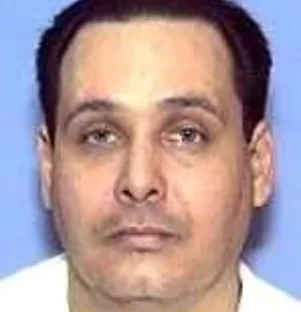
1961 - 2006
Summary
Name:
Richard HinojosaNickname:
HawkeyeYears Active:
1986 - 1994Birth:
November 17, 1961Status:
ExecutedClass:
MurdererVictims:
2Method:
Stabbing / ShootingDeath:
August 17, 2006Nationality:
USA1961 - 2006
Summary: Murderer
Name:
Richard HinojosaNickname:
HawkeyeStatus:
ExecutedVictims:
2Method:
Stabbing / ShootingNationality:
USABirth:
November 17, 1961Death:
August 17, 2006Years Active:
1986 - 1994Date Convicted:
July 21, 1997"I know you may hate me for whatever reason. The Lord says hate no one. I hope you find peace in your hearts."
— Richard Hinojosa
Richard Hinojosa was born on November 17, 1961, and spent most of his life in the San Antonio, Texas area, where he worked as a construction laborer and, at one point, as a custodian at a club on the grounds of San Antonio's former Brooks Air Force Base. By adulthood he had been married four times.
In 1986, Hinojosa shot and killed a man in Bexar County. He later acknowledged the killing and accepted a plea agreement, receiving an eight-year sentence for voluntary manslaughter and robbery by threats. He served roughly two and a half years before being released to mandatory supervision in December 1988; his sentence was formally discharged in November 1994.
By the early 1990s, Hinojosa was living next door to his father in suburban San Antonio. A woman named Terry Wright lived in the neighboring house. According to Hinojosa's own account, given in an interview shortly before his execution, he and Wright began a relationship after she moved in next door, during a period when Hinojosa's then-wife would periodically leave the household for a week or two at a stretch. Hinojosa maintained that this relationship was consensual and ongoing at the time of Wright's death, a claim that would later become central to his defense at trial.
On the morning of May 10, 1994, 29-year-old Terry Wright failed to arrive at work. When co-workers grew concerned and contacted her family, Wright's father drove to her suburban San Antonio home to check on her. He discovered a window leading into an enclosed atrium had been broken open, and the interior of the house was in disarray. Muddy footprints led toward her bedroom, her jewelry box appeared to have been searched, the cord of an electric fan had been cut, and her nightgown, torn at the straps, was found on the floor. Wright's car was missing and the home's telephone lines had been cut.
Later that same day, police located Wright's car abandoned near a freeway intersection. Investigators followed a trail of leaking transmission fluid to a dirt road, where they found Wright's body in a nearby field, unclothed and partially covered with grass. An autopsy determined she had been stabbed eleven times in the chest and back; the medical examiner testified that five wounds had penetrated her heart and another had penetrated a lung, and that the wound pattern suggested her heart had specifically been targeted. The weapon itself was never recovered — the grand jury's indictment described it only as "an object unknown to the grand jury" — though investigators and subsequent news reporting believed it to have been a screwdriver. Sperm recovered from Wright's body was later matched through DNA testing to Hinojosa. Wright's boyfriend, who told investigators he had last spoken with her by phone the previous night, was ruled out as the source of that evidence.
Hinojosa, then 32 and living next door with his father, was questioned early in the investigation because he was on parole at the time for his earlier manslaughter conviction. He told police he had returned home from work around 11:00 p.m. the night of the crime and did not leave again until early the next morning; family members in his household corroborated this account, and the initial investigation did not immediately implicate him further.
The case advanced in December 1994, when Hinojosa was arrested on an unrelated domestic violence accusation. While he was in custody on that charge, authorities collected a DNA sample from him, which was later matched to genetic material recovered from Wright's body. Investigators also matched footprints found inside Wright's home and at the scene where her body was discovered to the specific brand and model of athletic shoe that Hinojosa's wife had purchased for him several months before the murder. Hinojosa was subsequently arrested and charged with Wright's murder.
A Bexar County grand jury indicted Hinojosa for capital murder on August 15, 1995, charging in four separate paragraphs that he had killed Wright while in the course of committing or attempting to commit burglary, kidnapping, robbery, and aggravated sexual assault. At trial, which began on July 14, 1997, Hinojosa testified that he and Wright had been involved in a consensual affair and denied any involvement in her death, a defense his attorneys argued could account for the presence of his DNA and fingerprints at the scene. Prosecutors countered with physical evidence indicating forced entry through the atrium window and the matching shoeprint evidence, arguing these details were inconsistent with a consensual encounter. On July 21, 1997, the jury convicted Hinojosa of capital murder, and on July 25, 1997, the trial judge formally sentenced him to death in accordance with the jury's answers to the state's capital sentencing questions. The Texas Court of Criminal Appeals affirmed both the conviction and the sentence in October 1999, and his subsequent appeals through the state and federal court systems, including a final challenge before the U.S. Supreme Court regarding the constitutionality of the lethal injection process, were all denied.
In an interview granted from death row roughly two weeks before his execution, Hinojosa continued to maintain his innocence in Wright's death while acknowledging his earlier manslaughter conviction. He expressed a wish that his youngest son be permitted to witness the execution, stating that the experience might help guide the teenager toward a positive path in life.
Richard Hinojosa was executed by lethal injection on August 17, 2006, at the Huntsville Unit in Huntsville, Texas. In his final statement, delivered as a storm moved over the prison, he addressed Wright's family members who were present, telling them he hoped they could find peace and stating that he bore them no ill will. He was pronounced dead at 6:19 p.m., becoming the 18th inmate executed in Texas that year.
