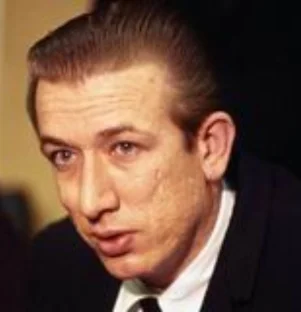
1941 - 1991
Summary
Name:
Richard Franklin SpeckNickname:
SpeckYears Active:
1966Birth:
December 06, 1941Status:
DeceasedClass:
Mass MurdererVictims:
8Method:
Strangulation / StabbingDeath:
December 05, 1991Nationality:
USA1941 - 1991
Summary: Mass Murderer
Name:
Richard Franklin SpeckNickname:
SpeckStatus:
DeceasedVictims:
8Method:
Strangulation / StabbingNationality:
USABirth:
December 06, 1941Death:
December 05, 1991Years Active:
1966Date Convicted:
April 15, 1967“It just wasn’t their night.”
— Richard Franklin Speck
Richard Franklin Speck was born on December 6, 1941, in Kirkwood, Illinois. He was the seventh of eight children in his family. Speck and his younger sister, Carolyn, were much younger than their older siblings. His father, Benjamin Franklin Speck, worked as a packer at Western Stoneware and passed away from a heart attack when Richard was just six years old. This left a significant impact on him.
After his father’s death, Richard’s mother, Mary Margaret Carbaugh Speck, married Carl August Rudolph Lindberg, a traveling insurance salesman from Texas. Lindberg had a troubled past, including a history of alcohol abuse and criminal activity. Speck had a difficult relationship with his stepfather, who was often drunk and abusive.
In the early 1950s, the family moved to various places in Dallas, Texas. Speck struggled in school. He was marked as a poor student and needed glasses but refused to wear them. He dropped out of high school at 16 after failing all his classes. He began drinking alcohol at a young age and soon developed a habit of getting intoxicated almost daily.
Speck's early legal troubles began when he was arrested at 13 for trespassing. He accumulated numerous arrests over the years, leading to a pattern of minor crimes. At one point, he worked as a laborer for a beverage company. During this time, he met a girl named Shirley Annette Malone, whom he married when he was 20. Their marriage was troubled and marked by conflict, abuse, and legal issues. After they had a child, Speck was often in and out of jail.
In 1966, his wife filed for divorce. During this chaotic period, Speck was arrested for burglary and attempted to evade more serious charges for other crimes. Fearing another prison sentence, he left Dallas and moved to Chicago, where he stayed with relatives and continued engaging in criminal activity.
By summer 1966, Speck was living a transient lifestyle, moving between different places in Chicago. He seemed to be struggling mentally and emotionally, often drinking heavily. He had already developed a reputation for violence and had begun to attract the attention of law enforcement due to various disturbances and illegal activities.
On July 14, 1966, Richard Speck broke into a townhouse in Chicago where eight student nurses were living. He took them hostage, methodically attacking and murdering each of them throughout the night. The victims included Gloria Davy, Patricia Matusek, Nina Schmale, Pamela Wilkening, Suzanne Farris, Mary Ann Jordan, Merlita Gargullo, and Valentina Pasion.
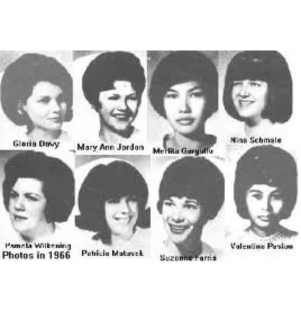
Speck entered the townhouse late in the evening, armed with a knife. He held the women for hours, subjecting them to violence and ultimately killing them in a brutal fashion. Most of the women were stabbed or strangled. One of the nurses, Cora Amurao, managed to escape by hiding underneath a bed during the attacks. She was the only survivor.
After the murders, Speck attempted to evade capture. He spent several days in the area and was finally apprehended on July 17, 1966, after being recognized by medical staff at Cook County Hospital due to a tattoo linking him to the crimes. Cora Amurao identified him as the attacker, which was crucial evidence against him.
The trial began in 1967, and after a brief deliberation, the jury found him guilty of multiple counts of murder. Speck was sentenced to death initially, but his sentence was later commuted to several hundred years in prison after the U.S. Supreme Court ruled the death penalty unconstitutional in 1972.
While serving his sentence, Speck was known for his problematic behavior and was often caught with contraband in prison. He died of a heart attack on December 5, 1991, one day before his 50th birthday. His remains were cremated and not claimed by any family.
