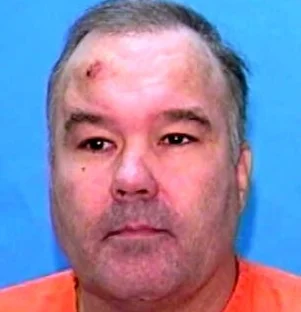
b: 1954
Summary
Name:
Ray Lamar JohnstonYears Active:
1997Birth:
October 24, 1954Status:
Awaiting ExecutionClass:
MurdererVictims:
2Method:
StrangulationNationality:
USAb: 1954
Summary: Murderer
Name:
Ray Lamar JohnstonStatus:
Awaiting ExecutionVictims:
2Method:
StrangulationNationality:
USABirth:
October 24, 1954Years Active:
1997Date Convicted:
June 17, 1999“I strangled her and took her life.”
— Ray Lamar Johnston
Ray Lamar Johnston was born on October 24, 1954. Public records identify him as a white male from the United States. Johnston’s prior criminal record began decades before the murders. Court records show that he had been convicted of violent crimes committed against women in the 1970s and 1980s. These included robberies and rape connected to a 1973 Alabama convenience store case and a 1974 offense against Susan Reeder. He was also convicted in Georgia in relation to a 1974 offense against Judy Elkins.
In 1988, Johnston was also linked to violent attacks against Julia Maynard and Carolyn Peak in Florida. In one case, he was accused of attacking a woman inside her residence, restraining her, and threatening her. In another, he abducted Carolyn Peak as she was getting out of her car at an apartment complex. A police stop interrupted the attack, and officers found items including a camera, surgical gloves, and a mask. Johnston later pleaded guilty to or was found guilty of charges including armed kidnapping and burglary with assault and received an 18-year prison sentence in September 1988.
Despite that sentence, Johnston was released from prison in May 1996. Within the following year, he committed the murders of Janice Nugent and Leanne Coryell in Hillsborough County, Florida.
Janice Nugent was killed in Hillsborough County, Florida, in early February 1997. Her body was discovered by her son-in-law, John McCarthy, on the evening of February 7, 1997. When McCarthy arrived at her home, he noticed that a side door was partly open and that keys remained in the door lock. He found Nugent’s body wrapped in a bed comforter and submerged in the bathtub. She was wearing only panties and a bra. A medical examiner determined that she had been manually strangled and that her time of death was between 1:00 a.m. on February 6, 1997, and 1:00 a.m. on February 7, 1997.
The medical examiner also determined that Nugent had been killed before her body was placed in the bathtub. She had extensive bruising to the neck and shoulders, defensive wounds on her hands and arms, and three to five impact wounds to the hips and buttocks. Those injuries were consistent with having been caused by a belt or possibly a vacuum cleaner hose. Fingerprints were recovered from the bottom of a plastic cup under the kitchen table and from the cold-water knob of the bathtub. Shoe tracks were found on the kitchen floor, and blood and saliva or sweat were recovered from a sheet in the bedroom. The forensic evidence was later matched to Johnston.
Johnston knew Nugent before the murder. Police interviewed him several times before trial. When confronted with forensic evidence placing him at the scene, Johnston claimed that Nugent had spilled hot massage oil on him while massaging him and that he then used her shower to wash himself off. He denied killing her for more than two decades.
Several months later, on August 19, 1997, Leanne Coryell was murdered in Hillsborough County. Coryell worked as a clinical orthodontic assistant. She left work at 8:38 p.m. and later went to a Publix grocery store, where surveillance footage showed her checking out at 9:23 p.m. She was not seen alive again.
At about 10:30 p.m., Coryell’s body was found floating in a pond on the property of St. Timothy’s Church. Forensic investigators determined that she died from manual strangulation and had wounds suggesting blunt-force impact. Scrapes on her back indicated that she had been dragged to the pond. Her body also showed injuries consistent with sexual penetration, and forensic experts concluded that unusually shaped bruises on her buttocks were likely caused by being beaten with her own belt.
Coryell’s clothing was found on a nearby embankment, and investigators recovered shoe impressions near the clothing. Her black Infiniti was found in the church parking lot with the keys in the ignition and the engine still warm. Police lifted a fingerprint from the outside of the vehicle that was later matched to Johnston. ATM surveillance images also showed someone withdrawing $500 from Coryell’s bank account. After the images were broadcast by news media, a person who knew Johnston contacted police.
Police obtained a search warrant for Johnston’s apartment and found wet tennis shoes and shorts. The shoes matched three partial impressions recovered from the crime scene. Johnston later contacted police after seeing his photograph on television and gave a statement. He claimed that he and Coryell were friends, that they had gone to dinner together, and that he withdrew money from her account to repay a loan. He also claimed his shoes were wet because he had jumped into a hot tub while still wearing them after a run.
Johnston also attempted to create a false alibi. According to the Florida capital case summary, he called a pen pal and asked her to tell his attorneys that she had been working out with him on the night Coryell was murdered.
On September 10, 1997, Johnston was indicted in the Coryell case on charges of first-degree murder, kidnapping, robbery, sexual battery, and burglary of a conveyance. On June 17, 1999, a jury found him guilty on all counts. That same day, the jury recommended death by a vote of 12 to 0. On March 13, 2000, Johnston was sentenced to death for first-degree murder. He also received life sentences for kidnapping, sexual battery, and burglary of a conveyance, plus a 15-year sentence for robbery.
Johnston was later tried separately for the murder of Janice Nugent. He was indicted on January 30, 1999, and on October 6, 2000, a jury found him guilty of first-degree murder. On April 12, 2001, the jury recommended death by a vote of 11 to 1, and on August 22, 2001, he was sentenced to death in that case. The Florida Supreme Court affirmed the conviction and sentence in 2003.
In later years, changes in Florida death penalty law affected Johnston’s Nugent sentence because the jury recommendation in that case had not been unanimous. In 2021, prosecutors prepared for a third penalty-phase proceeding, but Johnston admitted in court that he killed Nugent. After his statement, the state agreed not to pursue another death sentence in the Nugent case. His sentence for Nugent’s murder converted to life imprisonment, while he remained on death row for Coryell’s murder. Ray Lamar Johnston remains under a death sentence in Florida for the murder of Leanne Coryell.
