b: 1939
Summary
Name:
Peter Kuzmich VolynskyYears Active:
1971Birth:
November 25, 1939Status:
ImprisonedClass:
Mass MurdererVictims:
10Method:
BombingNationality:
Soviet Unionb: 1939
Summary: Mass Murderer
Name:
Peter Kuzmich VolynskyStatus:
ImprisonedVictims:
10Method:
BombingNationality:
Soviet UnionBirth:
November 25, 1939Years Active:
1971“I hate people.”
— Peter Kuzmich Volynsky
Peter Kuzmich Volynsky was born on 25 November 1939 in the city of Krasnodar, then part of the Russian Soviet Federative Socialist Republic within the Soviet Union. Little is publicly documented about his early family life or childhood, though available records suggest he grew up without notable criminal history during his youth.
Volynsky later enrolled at Kuban State Medical University, pursuing higher education in medicine. Former classmates described him as socially withdrawn and unremarkable in appearance, though he was known for consistently carrying a suitcase with him, a habit that drew attention even before the crime. During his time as a student, Volynsky began exhibiting increasingly unusual behavior, including social isolation, paranoia, and fixation on perceived slights.
At some point during his studies, Volynsky was diagnosed with schizophrenia. Despite this diagnosis, he was allowed to complete his education and graduated from medical school. Afterward, he worked at several hospitals in the Krasnodar region. Colleagues later recalled that he continued to display erratic and unprofessional conduct, which raised concerns but did not result in permanent removal from medical practice.
Volynsky maintained personal journals in which he recorded obsessive thoughts and grievances. Among these writings was a recurring theme of hostility toward people he perceived as physically superior to himself, particularly individuals taller than him. These notes indicated a growing fixation on revenge and a belief that he had been systematically wronged by society at large.
By the late 1960s, Volynsky’s mental condition had deteriorated further. He became increasingly isolated and secretive, while simultaneously developing technical skills related to explosives.
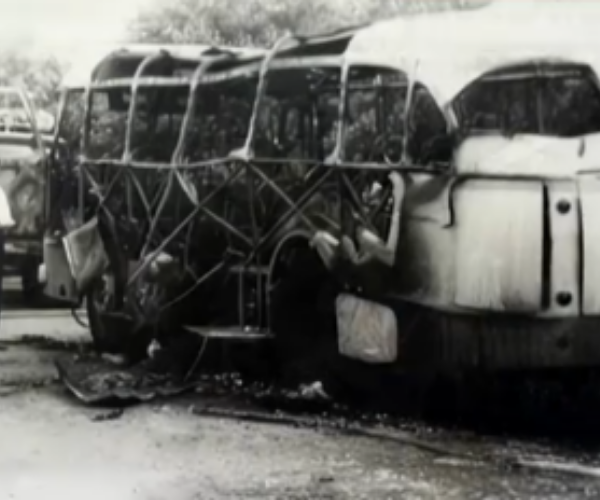
On the morning of 14 June 1971, Peter Volynsky carried out one of the deadliest acts of mass violence in Soviet civilian transport history. At approximately 8:20 a.m., he boarded a city bus in Krasnodar carrying a suitcase that concealed a homemade explosive device. He placed the suitcase near the bus’s fuel tank.
Shortly after the bus departed, Volynsky exited the vehicle. According to one account, he claimed to be feeling ill and urgently requested that the driver let him off. Another version states that he disembarked at the next scheduled stop. Roughly ten minutes later, at approximately 8:30 a.m., the bomb detonated while the bus was traveling along Turgenev Street.
The explosion was powerful enough to lift the bus into the air. The device was packed with metal balls, nails, and bearings, which amplified the lethality of the blast. The explosion ruptured the fuel tank, causing an immediate fire inside the vehicle. Five passengers were killed instantly, while others sustained severe burns and traumatic injuries.
Despite being injured, the bus driver managed to force open the jammed doors and break a window using a mounting tool, allowing some passengers to escape. Those who were incapacitated by injuries were unable to flee and were burned inside the bus. In total, ten people died, with five victims succumbing to their injuries later in hospital. Estimates of the wounded range from 20 to as many as 90 people.
Witnesses reported seeing a man wearing a cap and carrying a large black suitcase shortly before the explosion. Investigators later recovered fragments of the device, including parts of a fire extinguisher used in the bomb’s construction.
The investigation was led by the KGB, which identified Volynsky as a suspect within two days. He was located and detained around 16 June 1971. A search of his apartment revealed gas cylinders, gunpowder, disassembled bearings, a box containing bomb components, and nichrome wire. Investigators concluded that the materials present were sufficient to destroy a multi‑story residential building.
Among the items found was a portrait of Napoleon Bonaparte bearing the inscription, “I can do anything.” Volynsky had also meticulously documented the cost of constructing explosive devices, allowing investigators to determine that the bomb used in the attack cost approximately 40 rubles to assemble.
During interrogation, Volynsky was asked what motivated him to commit the bombing. He reportedly responded with a single sentence: “I hate people.”
A comprehensive forensic psychiatric evaluation determined that Volynsky was legally insane at the time of the attack. He was therefore deemed not criminally responsible under Soviet law and was committed to compulsory treatment in a closed psychiatric hospital in the Novy Abinsky District of Krasnodar Krai.
For many years, Volynsky was rumored to have died or disappeared. However, later reporting by Russian media, citing credible sources, stated that he was still alive and residing in a psychiatric institution as of February 2015.
