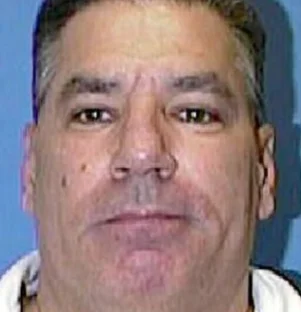
1950 - 2007
Summary
Name:
Michael Durwood GriffithYears Active:
1994Birth:
July 11, 1950Status:
ExecutedClass:
MurdererVictims:
1Method:
StabbingDeath:
June 06, 2007Nationality:
USA1950 - 2007
Summary: Murderer
Name:
Michael Durwood GriffithStatus:
ExecutedVictims:
1Method:
StabbingNationality:
USABirth:
July 11, 1950Death:
June 06, 2007Years Active:
1994“Please take my spirit to the Lord.”
— Michael Durwood Griffith
Michael Durwood Griffith was born on July 11, 1950. Griffith worked in law enforcement for approximately ten years as a Harris County sheriff’s deputy. His personnel record included positive evaluations and commendations, and several former colleagues described him as competent and professional. However, testimony also documented repeated violence against wives, girlfriends and members of his family. He was dismissed from the department in January 1993 after a misdemeanor domestic-abuse conviction.
After losing his position, Griffith worked for a cleaning service. By October 1994, he was using alcohol and the prescription painkiller Demerol. These circumstances were discussed during the case but did not reduce his legal responsibility for the murder.
On the morning of October 10, 1994, Deborah McCormick was working with her mother, Mary Jane Ringer, at their family-owned flower shop and wedding chapel in northwest Houston. Ringer left at approximately 8:15 a.m., leaving about $400 in cash and several family credit cards at the business. Because only one person remained inside, the shop’s door was locked and was opened only for known customers.
Griffith had previously purchased flowers from the shop, so McCormick recognized him and allowed him inside. He selected roses before producing a firearm, robbing her and forcing her into a back room. There, he sexually assaulted her and repeatedly stabbed her with a knife.
When Ringer returned approximately 30 minutes later, she found her daughter lying in blood. McCormick’s clothing had been disturbed, cash and credit cards were missing and the shop showed evidence of the attack. The medical examiner found stab wounds to her hands, back, chest and abdomen and concluded that wounds to the chest and abdomen caused her death. Forensic testing also confirmed the sexual assault.
Griffith began using the stolen credit cards shortly after the murder. Over the following weeks, he used them to pay for restaurant meals, hotel rooms and gifts while signing the name of McCormick’s father. Witnesses later connected those purchases to Griffith.
Four days after the murder, Griffith robbed a savings-and-loan office. After taking money, he shot the female employee in the back of the head. She survived. On October 28, he robbed a bridal shop, forced its female employee into a back room and sexually assaulted her at gunpoint and knifepoint before tying her up. These attacks were introduced during the punishment phase of his murder trial.
Police traced the stolen cards to a motel room registered under the name “Billy Ringer.” Griffith was arrested there in early November 1994 under outstanding warrants. During the search, officers found the stolen credit cards, Griffith’s identification and a knife concealed between the bed and box spring. A receipt from McCormick’s shop was recovered from his vehicle.
Forensic testing found both Griffith’s and McCormick’s DNA on the knife. Griffith’s DNA was also recovered from evidence associated with the sexual assault, and hair found on McCormick’s body matched his sample. The physical evidence, stolen cards and purchase records directly connected him to the crime.
A Harris County jury convicted Griffith of capital murder in December 1995 for killing McCormick while robbing her. During the punishment phase, prosecutors presented his history of violence against women, the two subsequent armed attacks and expert testimony addressing his likelihood of committing further violence. The defence presented his law-enforcement record, childhood history and psychological evidence.
The jury found that Griffith would present a continuing danger and that the mitigating evidence did not justify a life sentence. The trial judge imposed the death penalty. Griffith also received a separate 60-year prison sentence for the savings-and-loan and bridal-shop offenses.
On December 16, 1998, the Texas Court of Criminal Appeals affirmed his conviction and death sentence. The court rejected his claims involving the motel search, the denial of funding for an additional expert, the prosecution’s future-dangerousness testimony, victim-impact evidence and the jury’s consideration of mitigation. The United States Supreme Court declined review in 1999.
The Texas Court of Criminal Appeals denied state habeas relief on October 8, 2003. A federal district court denied his habeas petition on September 27, 2005. On July 21, 2006, the Fifth Circuit refused to issue a certificate of appealability, concluding that his claims did not justify further federal review.
Michael Durwood Griffith was executed by lethal injection at the Huntsville Unit on June 6, 2007. He formally declined to give a final statement but quietly asked for his spirit to be taken to the Lord as the drugs were administered. He was pronounced dead at 6:18 p.m. at the age of 56.
