
d: 1965
Summary
Name:
Michael Andrew ClarkYears Active:
1965Status:
DeceasedClass:
Mass MurdererVictims:
3Method:
ShootingDeath:
April 25, 1965Nationality:
USAd: 1965
Summary: Mass Murderer
Name:
Michael Andrew ClarkStatus:
DeceasedVictims:
3Method:
ShootingNationality:
USADeath:
April 25, 1965Years Active:
1965Michael Andrew Clark was born in the late 1940s and lived with his parents in Long Beach, California. At the time of the shooting, he was 16 years old and legally a minor. Public records and contemporary newspaper accounts provide limited information about his upbringing, education, or mental health history. There is no evidence that Clark had a criminal record prior to the events of April 1965.
Clark’s father owned several firearms that were kept in a locked gun safe inside the family home. Despite this, Clark was able to access and remove a military rifle, a handgun, and a substantial amount of ammunition without his parents’ knowledge or consent. No suicide note or explanation for his actions was ever recovered, and investigators were unable to determine a clear motive for the attack.
Late on the night of April 24, 1965, Michael Andrew Clark left his family home in Long Beach, California, taking his parents’ car without permission. In the vehicle, he carried a Swedish Mauser military rifle equipped with a telescopic sight, a pistol taken from his father’s locked gun safe, and a large quantity of ammunition. He drove north through the night and arrived near the unincorporated community of Orcutt in Santa Barbara County during the early morning hours of April 25.
Before dawn, Clark climbed a hill overlooking a stretch of U.S. Highway 101 just south of Orcutt. As daylight broke, he positioned himself above the roadway and began firing at passing vehicles. Motorists traveling the highway were unaware of the danger until bullets began striking their cars. Clark fired repeatedly over several hours, targeting vehicles at random as they moved along the roadway below.
Two adult men were fatally shot during the attack. According to later reports, both men had stopped their vehicles in an attempt to assist others whose car had been disabled by the gunfire. In addition to the fatalities, numerous motorists and passengers were wounded. Some were struck directly by bullets, while others suffered injuries from shattered glass and metal fragments as rounds pierced windshields and car bodies.
Deputies from the Santa Barbara County Sheriff’s Office eventually located Clark’s position on the hillside and began moving toward him. As law enforcement officers closed in, Clark fatally shot himself, bringing the attack to an end. The entire incident left the surrounding area in chaos and prompted an extensive emergency response along the highway corridor.
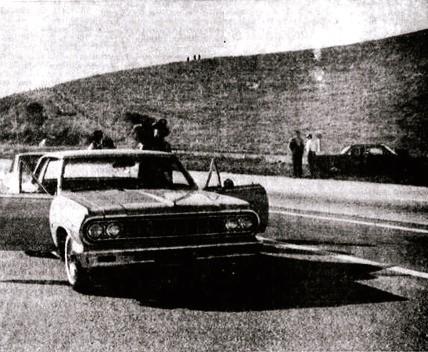
On April 26, 1965, a five‑year‑old boy who had been shot in the head during the attack died from his injuries, increasing the total number of fatalities to three. The shooting remains one of the earliest documented examples of a sniper-style attack targeting motorists on a major American highway.
Those killed were Charles Christopher Hogan, age 21; Joel W. Kocab, age 28; and Kevin Dean Reida, age 5.
Those wounded included Doris Burson, age 24; Alice Jones, age 31; Marvine Jones, age 12; Bill Reida, age 42, who was shot in the neck; Lucille Reida, age 44; Kim Alan Reida, age 3; Norbert Schuerman, age 38, a police officer shot in the left arm; Kathleen Smith, age 22; Renee Terry, age 15, who was shot in the right forearm; Leona Weber, who sustained a wrist injury from shrapnel; and Joy Ziomek, age 39, who suffered an arm injury from glass fragments.
Following the shooting, civil lawsuits were filed by victims William, Lucille, and Kim Reida against Clark’s parents, Forest and Joyce Clark. The plaintiffs alleged negligence, claiming that the parents failed to properly supervise their son and failed to adequately secure firearms within the home. The trial court ruled in favor of the Clarks.
On appeal, the ruling was largely upheld, though the appellate court acknowledged negligence on the part of Forest Clark for not sufficiently securing the weapons. Despite this finding, the court did not impose liability that altered the outcome of the case. The legal proceedings became an early reference point in discussions regarding parental responsibility and firearm storage when minors gain access to weapons.
The 1965 Highway 101 sniper shooting shocked California residents and drew national attention due to the randomness of the attack and the young age of the perpetrator. At the time, such incidents were extremely rare, and the case has since been cited in historical studies examining early mass shootings, highway safety, and firearm access by juveniles.
