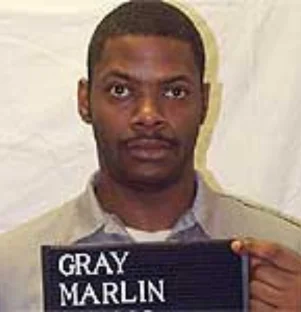
1967 - 2005
Summary
Name:
Marlin Andrew GrayYears Active:
1991Birth:
September 29, 1967Status:
ExecutedClass:
MurdererVictims:
2Method:
DrowningDeath:
October 26, 2005Nationality:
USA1967 - 2005
Summary: Murderer
Name:
Marlin Andrew GrayStatus:
ExecutedVictims:
2Method:
DrowningNationality:
USABirth:
September 29, 1967Death:
October 26, 2005Years Active:
1991Date Convicted:
October 21, 1992“I go with a peace of mind that comes from never having taken a human life.”
— Marlin Andrew Gray
Marlin Andrew Gray was born on September 29, 1967. By 1991, at age 23, he was the oldest and largest member of a group that included Reginald "Reggie" Clemons and two younger, juvenile associates, 16-year-old Antonio "Tony" Richardson and 15-year-old Daniel Winfrey. On the evening of April 4, 1991, the four met at the home of a mutual friend in St. Louis, Missouri; at Gray's suggestion, the group left for the abandoned Chain of Rocks Bridge, spanning the Mississippi River, to smoke marijuana Gray had obtained.
Meanwhile, sisters Julie Kerry, 20, and Robin Kerry, 19, had arranged to meet their 19-year-old cousin, Thomas Cummins, at the same bridge shortly before midnight. The bridge, long closed to vehicle traffic, had become a popular site for trespassers to drink and socialize. The sisters wanted to show Cummins a poem they had spray-painted in graffiti on the bridge itself.
The two groups encountered each other on the bridge and spoke briefly before parting ways. A short time later, Gray and his companions returned, approached the three cousins, and surrounded them. Cummins was ordered to the ground while Julie and Robin were raped repeatedly by several of the men. According to the Missouri Supreme Court's account of the case, as the group moved the three toward a concrete pier below the bridge, Clemons remarked, "They'll never make it to shore," and Gray himself praised Richardson for being "brave" for pushing the Kerry sisters off the bridge into the river below. Cummins was then forced to jump as well.
Cummins survived the roughly 70-foot fall and swam to shore. Julie Kerry's body was recovered about three weeks later near Caruthersville, Missouri, far down the Mississippi River; Robin Kerry's body was never found. The sisters share a single headstone at Calvary Cemetery in St. Louis.
In the immediate aftermath, homicide investigators initially suspected Cummins himself of killing his cousins and fabricating the story about the other men, in part because he was found completely dry with no apparent injuries despite his account of jumping into the river. Under intensive questioning, and after failing a polygraph test, Cummins gave an account in which he said he had tried to have sex with Julie, she resisted, they argued, and he pushed her, causing her to fall from the bridge; he said he then "blacked out," believing Robin either jumped in after her sister or that he had pushed her as well. Police arrested Cummins and publicly announced the case solved. Charges against Cummins were later dropped once investigators identified Gray, Clemons, Richardson, and Winfrey as the actual perpetrators; Cummins went on to testify against all four men, successfully identifying each of them, and later received $150,000 in damages over how he had been treated by police during his own interrogation.
Once in custody, Gray admitted in a taped statement that he had participated in raping both Kerry sisters but denied involvement in the murders themselves; he later claimed this statement had been obtained through police coercion, though it was ultimately admitted as evidence at trial and was found largely consistent with the established facts of the case.
Gray was the first of the four men to stand trial, and at trial he denied all involvement in the crimes. He was convicted on two counts of first-degree murder on December 9, 1992, and was sentenced to death. The Missouri Supreme Court affirmed his conviction and sentence on direct appeal in 1994 (State v. Gray).
The four men involved in the Kerry sisters' deaths ultimately faced significantly different outcomes. Reginald Clemons was also convicted and sentenced to death in 1993, but his case was later reopened following allegations that his confession, like Gray's, had been coerced through police mistreatment; the Missouri Supreme Court ordered a new trial, and rather than face a full retrial, Clemons pleaded guilty to reduced charges in December 2017, avoiding execution. Antonio Richardson, a juvenile at the time of the crime, was also originally sentenced to death, but his sentence was later commuted to life without parole. Daniel Winfrey, the youngest of the four at 15, pleaded guilty early, in September 1992, to reduced charges of second-degree murder, rape, and armed robbery in exchange for truthful testimony against the others, receiving a sentence of no more than 30 years; he was paroled in June 2007 but had his parole revoked in both 2011 and 2012.
Marlin Andrew Gray was executed by lethal injection at the Eastern Reception, Diagnostic and Correctional Center in Missouri on October 26, 2005, at age 38. Missouri Attorney General Jay Nixon, whose office represented the state throughout Gray's appeals, said at the time, "The brutal murder of these two sisters shocked the community, and the sensibilities of all decent Missourians."
The case became widely known as the "Chain of Rocks Bridge Murders" and was the subject of the book A Rip in Heaven, written by Jeanine Cummins, Thomas Cummins's own sister, as well as episodes of true-crime documentary series examining both the murders and the wrongful early suspicion cast on Cummins.
