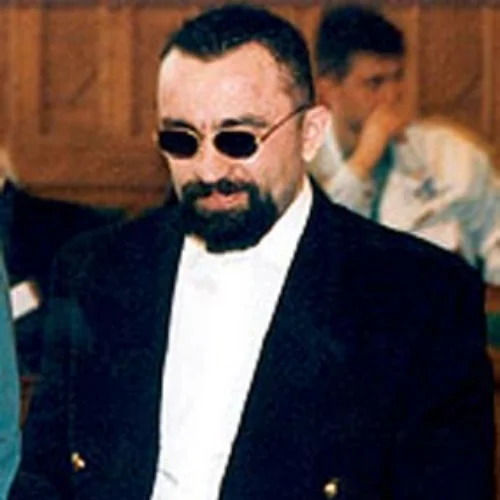
b: 1963
Summary
Name:
Marinko MagdaNickname:
Magda MarinkóYears Active:
1993 - 1994Birth:
November 30, 1963Status:
ImprisonedClass:
Mass MurdererVictims:
13Method:
ShootingNationality:
Serbia
b: 1963
Summary: Mass Murderer
Name:
Marinko MagdaNickname:
Magda MarinkóStatus:
ImprisonedVictims:
13Method:
ShootingNationality:
SerbiaBirth:
November 30, 1963Years Active:
1993 - 1994bio
Marinko Magda was born on 30 November 1963 in what was then the Socialist Republic of Serbia, part of the former Socialist Federal Republic of Yugoslavia. Little information has been made public about his early childhood, family background, or education, and no credible sources have confirmed any formal employment or military service records.
He came to public attention in the early 1990s after being implicated in multiple brutal homicides across Hungary and Serbia, during a period marked by political instability and porous borders following the disintegration of Yugoslavia.
At the time of the crimes, Magda was a Serbian citizen residing in or frequently traveling through Hungary. Investigations later revealed he was in possession of illegal firearms and had likely crossed borders with ease during the post-Yugoslav wars, which created conditions of weakened law enforcement cooperation across the region. His victims appeared to be chosen opportunistically, and there is no evidence he operated as part of any larger group or ideological movement.
He became one of the most infamous foreign serial killers to be prosecuted in Hungary and was linked to a total of 13 murders, committed over a short but highly violent timeframe from late 1993 to early 1994.
murder story
Marinko Magda’s killing spree began on 20 December 1993 in the Hungarian city of Kecskemét, where three people were found shot to death in a residential property. The victims identified as Horváth Antal, his wife, and Croatian national Dragutin Kujundžić were murdered with a firearm later found to be central to linking Magda to multiple homicides. Less than a month later, on 13 January 1994, Magda entered the home of the Z. Nagy family in Szeged, Hungary. There, he shot and killed Bálint Z. Nagy, a 42-year-old local confectioner, along with his 42-year-old wife and their two children, ages 16 and 10. The entire family was murdered in their apartment, and the case garnered national attention due to the brutality of the act and the ages of the victims. Forensic evidence soon revealed that the weapon used in the Nagy family murders was the same one used in the Kecskemét killings. Within two weeks, Hungarian police arrested Magda on 28 January 1994 as the prime suspect. Further investigation uncovered his involvement in additional homicides committed across the border in Serbia. In Subotica, Serbia, during 1994, he murdered five individuals Milan Petrić, Stana Petrić, Dane Petrić, Josip Agatić, and Verica Agatić again using the same firearm. While no consistent motive was ever established, all victims appeared to be selected opportunistically, with no clear link to Magda’s personal life. He was tried and convicted in Hungary in 1995 for three murders but was formally linked to a total of 13 killings in Hungary and Serbia. Magda received a life sentence and has remained incarcerated in Hungary ever since. His name has also been associated with continued violence during imprisonment, including a 2003 assault on a prison guard, for which he was fined in 2005. Despite the scale and brutality of his crimes, Marinko Magda has never publicly confessed or explained his actions.