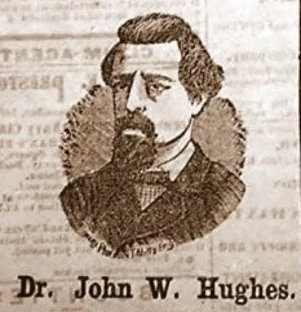
1833 - 1866
Summary
Name:
John William HughesYears Active:
1865Birth:
November 11, 1833Status:
ExecutedClass:
MurdererVictims:
1Method:
ShootingDeath:
February 09, 1866Nationality:
Manx / United Kingdom1833 - 1866
Summary: Murderer
Name:
John William HughesStatus:
ExecutedVictims:
1Method:
ShootingNationality:
Manx / United KingdomBirth:
November 11, 1833Death:
February 09, 1866Years Active:
1865Date Convicted:
December 22, 1865“The death penalty is ridiculous, and if you consider over it you find it is wrong.”
— John William Hughes
John William Hughes was born on November 11, 1833 on the Isle of Man. Records and later historical accounts describe him as coming from a financially comfortable family. After his father died, Hughes was sent to boarding school at a young age. He later pursued different paths before entering military service. Historical accounts state that he served with Her Majesty’s 5th Dragoon Guards during the Crimean War and was wounded at Balaklava.
After returning from military service, Hughes studied medicine and obtained medical training in the late 1850s. By 1860, after financial losses connected to drinking, gambling, and personal debts, he left Britain for the United States. He later joined the Manx community in Cleveland, Ohio, and worked as a physician. Sources also describe him as having a long history of heavy drinking, which became an important issue in both his personal life and later criminal defense.
Hughes was already married before he became involved with Tamzen Parsons. His first wife was named Margaret, and the couple had at least one child. After bringing his wife and young son to Cleveland in 1862, Hughes served for a time in the United States Navy and later had periods of service as a surgeon with the United States Army. By the fall of 1864, he had returned to Cleveland.
In late 1864, Hughes met Tamzen Parsons in Bedford, Ohio. He had been drinking heavily and stayed at the Parsons family home after attending a soldiers’ event. When he woke, Tamzen was nearby, and the two began speaking. Hughes later claimed that he told her about his domestic troubles. Their relationship developed quickly, despite the large age difference and the fact that Hughes was still legally married.
Hughes later showed Tamzen what appeared to be a divorce document. The document was false, but Tamzen reportedly believed him. On December 20, 1864, Hughes and Parsons went through a marriage ceremony in Pittsburgh, Pennsylvania. Her family soon learned that Hughes was still married, and Hughes was arrested for bigamy. He was convicted of bigamy and sentenced to one year in prison, but he was pardoned after serving about five months.
After his release in June 1865, Hughes returned to Cleveland. He did not return to a stable life with his first wife. Instead, he tried to renew his relationship with Tamzen Parsons. By this time, Tamzen and her family had learned the truth about his marriage status, and she refused to continue living with him. Hughes continued to visit Bedford and tried to convince her to go away with him.
On July 24, 1865, Hughes was found in Tamzen’s bedroom at about 2 a.m. by her father, Thomas Parsons. Hughes was armed and tried to pressure Tamzen into leaving with him. After this incident, Thomas Parsons filed legal complaints against Hughes for breaking and entering and assault and battery. Those charges were later withdrawn after Hughes posted a bond promising not to bother Tamzen or her family again.
On August 8, 1865, Hughes began drinking heavily in Cleveland. By that evening, he was moving between saloons with Oscar Russell, a saloonkeeper. Later, Hughes and Russell met a carriage driver named Ori Carr. Before leaving Cleveland, Hughes stopped at his medical office on Ontario Street and took a pistol from a trunk.
By the next morning, August 9, 1865, Hughes and the men were in Bedford. Hughes saw Tamzen Parsons and her mother returning from blackberry picking. He approached Tamzen and again demanded that she leave with him and live as his wife. Tamzen refused. After this confrontation, Hughes and the men returned to downtown Bedford, where more drinking occurred.
Later that day, Hughes learned that Thomas Parsons had gone to obtain a warrant for his arrest. Hughes then left in Carr’s carriage and continued looking for Tamzen. He saw her on Columbus Street near her family’s home and got out of the carriage. He again asked her to go with him. Tamzen refused and told him not to follow her.
After Tamzen refused him, Hughes drew his revolver. Witness accounts state that he said goodbye to her and referred to meeting her again “across the big waters.” He then grabbed her dress, placed the pistol near the back of her neck, and fired twice. One bullet entered near the spine below the base of the brain and penetrated her skull. Tamzen fell and died within moments.
Several people witnessed the shooting. A crowd pursued Hughes as he left the scene. He got into Carr’s carriage and forced the driver to flee. A larger group followed, including members of Tamzen’s family. Hughes later jumped from the carriage near the railroad tracks and ran into the woods. About two hours later, he was found hiding in bushes and was taken into custody the same day.
After his arrest, Hughes made statements that were later used to show intent and premeditation. According to historical accounts, he said he had gone to Bedford intending to kill Tamzen and claimed he was glad he had done it. He later changed his explanation and tried to blame the killing on alcohol and a sudden loss of control.
Hughes was indicted for first-degree murder. His trial began in Cuyahoga County on December 6, 1865, with Judge James Coffinberry presiding. The prosecution argued that Hughes had planned the killing and pointed to his prior threats against Tamzen. The defense argued that his actions were caused by alcohol, emotional instability, and insanity.
The jury rejected the defense argument. On December 22, 1865, after about two hours of deliberation, Hughes was found guilty of murder in the first degree. On December 30, 1865, Judge Coffinberry sentenced him to death by hanging.
After sentencing, efforts were made to have Hughes’ punishment commuted to life imprisonment. Those efforts failed. Ohio Governor Jacob Cox refused to commute the sentence. During his time in jail, Hughes wrote letters and poems and also spoke publicly against capital punishment. On February 7, 1866, he took a large dose of morphine in jail, but he survived after authorities intervened.
John William Hughes was executed by hanging on February 9, 1866, inside the Cuyahoga County jail. The Encyclopedia of Cleveland History also lists his execution date as February 9, 1866, and identifies him as a physician convicted of murdering Tamzen Parsons in Bedford.
Before the execution, Hughes gave a lengthy speech on the scaffold. At 1:07 p.m., he was dropped through the trap. Historical accounts state that his neck was broken and that he died quickly. His body was later released for burial.
