
Summary
Name:
Jesse WashingtonYears Active:
1916Status:
DeceasedClass:
MurdererVictims:
1Method:
BludgeoningNationality:
USASummary: Murderer
Name:
Jesse WashingtonStatus:
DeceasedVictims:
1Method:
BludgeoningNationality:
USAYears Active:
1916Jesse Washington was born in 1899 in Waco, Texas. He was an African American farmhand who grew up in a time when racial tensions were high in the Southern United States. Not much is known about his childhood or family background. Historical records suggest that he had limited schooling and was often described as illiterate. Some accounts also referred to him as "feeble-minded," indicating that he might have faced challenges in understanding complex situations or information.
Washington lived in a community heavily divided by race. The environment in which he grew up was marked by the effects of segregation and discrimination. Despite these hardships, he worked as a farmhand, a common occupation for many African Americans at that time. Life for black laborers was full of obstacles and dangers, especially in the Jim Crow South.
As a young man, Washington's life took a tragic turn. By the age of 17, he became involved in a case that drew significant attention. On May 8, 1916, he was arrested and charged with the murder of Lucy Fryer, a local white woman. This incident occurred in Robinson, Texas, a small town near Waco, where Fryer was found dead. The circumstances surrounding her death would soon ignite severe racial tensions in the area.
Washington's early life was shaped by the social and economic realities of his time. These factors played a crucial role in how his story unfolded in the years that followed.
On May 8, 1916, Jesse Washington was arrested in Waco, Texas. He was charged with the murder of Lucy Fryer, a 53-year-old woman. The murder took place in the doorway of her seed house. Washington confessed to both the murder and rape. Soon after, he was moved to the Dallas County Jail to keep him safe.
Washington's trial began on May 15, 1916. During the trial, a jury of twelve white men quickly found him guilty. They took only four minutes to decide on the verdict and sentenced him to death. As Washington was being taken away from the courtroom, a mob of white spectators grabbed him. They forced him down the courthouse stairs where a large crowd was waiting.
The mob dragged Washington to City Hall. Once there, they chained him to a tree and poured coal oil on him. They then set him on fire. Washington suffered greatly as he was beaten and mutilated before being burned. His body was later placed in a bag and paraded around the town of Robinson. Eventually, a local constable took the remains for burial.
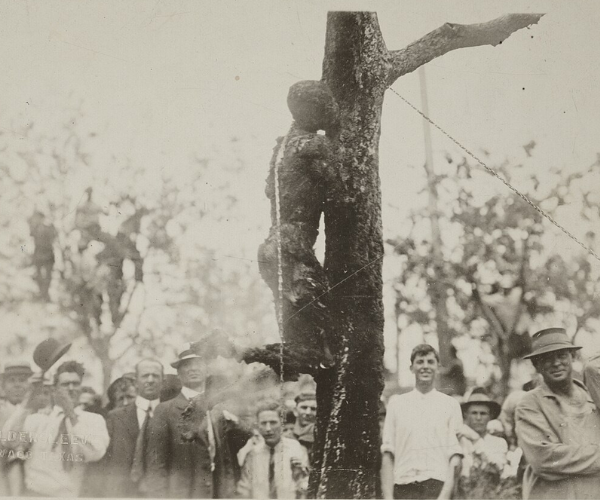
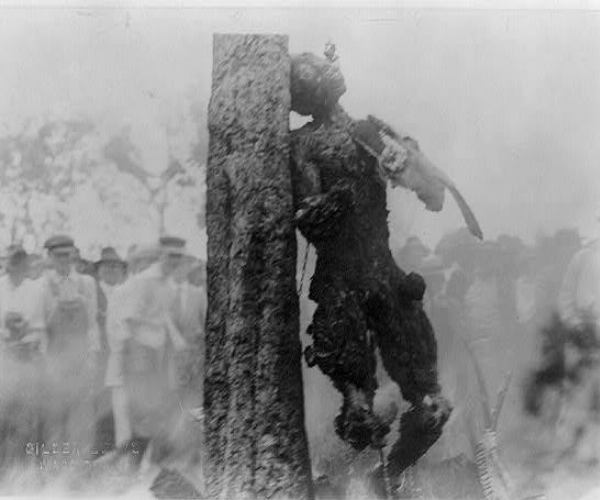
Despite the lynching violating Texas law, the mob members faced no punishment for their actions. Some individuals criticized local law enforcement for not protecting Washington from the mob. A journalist who suggested that someone else was responsible for the murder was arrested for his comments.
The incident received national attention and sparked outrage, especially among civil rights groups. The National Association for the Advancement of Colored People took up the cause and pushed for stronger anti-lynching laws in the future. As a result, the story of Jesse Washington remains a significant part of history.
