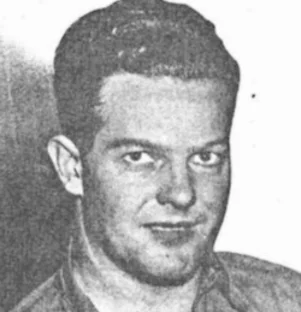
1921 - 1946
Summary
Name:
James Waybern HallNickname:
Big Jim / Red / The Arkansas ButcherYears Active:
1944 - 1945Birth:
January 28, 1921Status:
ExecutedClass:
Serial KillerVictims:
4Method:
ShootingDeath:
January 04, 1946Nationality:
USA1921 - 1946
Summary: Serial Killer
Name:
James Waybern HallNickname:
Big Jim / Red / The Arkansas ButcherStatus:
ExecutedVictims:
4Method:
ShootingNationality:
USABirth:
January 28, 1921Death:
January 04, 1946Years Active:
1944 - 1945"Boys, I'm not afraid. I can take it."
— James Waybern Hall
James Waybern Hall was born on January 28, 1921, in Arkansas. He was one of ten children born into a large rural family. His father was reportedly both a preacher and a farmer, and later accounts from relatives described the household as strict and physically demanding.
Researchers who later examined Hall's life reported that he may have suffered a serious head injury as a child, possibly resulting from a beating. Family members described lasting physical effects, including an unusual gait and discoloration of the hair on one leg. However, no medical records have been located that conclusively document the injury or establish any direct connection between it and his later crimes.
Hall spent much of his youth drifting between jobs and frequently traveled throughout the United States. He developed a reputation for hitchhiking and moving from place to place, often working only briefly before leaving. By the early 1940s, he had accumulated a criminal record that included theft and other offenses.
In 1943, Hall was drafted into the United States Navy during World War II. Reports indicate that he attempted to avoid military service and was dishonorably discharged after only eight weeks of training.
After returning to Little Rock, Arkansas, Hall married nineteen-year-old Fayrene Clemmons on March 14, 1944. Their marriage quickly became troubled, and the couple separated for a short period during the summer of that year. Their relationship deteriorated further during the following months and ended in violence.
On September 28, 1944, Hall went to his father-in-law and reported that his wife, Fayrene, had left him three days earlier. Authorities investigated and concluded that the young woman had likely run away. Their theory appeared to gain support when relatives later received a Christmas card bearing Fayrene's signature and postmarked from Bakersfield, California.
However, Hall borrowed the card and envelope before investigators could examine them, and the items subsequently disappeared. Months later, after Hall's arrest, detectives learned that Fayrene had never left Arkansas. Hall eventually led investigators to a burial site where he had hidden her remains. A farmer had previously found her skull, but it had not been identified at the time. Her remains were ultimately identified through her distinctive teeth.
On January 29, 1945, an abandoned automobile was discovered in Ouachita County, Arkansas. Inside was the body of Camden barber Carl Hamilton, who had been shot through the chest. Investigators initially had no reason to connect the killing to the disappearance of Fayrene Hall.
The murders escalated on February 1, 1945. E. C. Adams disappeared while traveling to work at a Little Rock war plant. His vehicle was later found near Fordyce, Arkansas, and searchers located his body nearby. He had been shot once in the head.
That same day, truck driver Doyle Mulherin vanished while making a meat delivery. His truck was discovered near Stuttgart, Arkansas, and a search of the area uncovered his body. He had also been shot in the head, and approximately $125 in company funds was missing.
Authorities still had no suspect until March 2, 1945, when Hall was arrested after a bar fight in Little Rock. During the investigation, an acquaintance informed police that he had loaned Hall a car on January 28. A pistol had been left in the vehicle's glove compartment, and one cartridge was missing when Hall returned the car.
Ballistics testing established that the pistol had been used to murder Carl Hamilton. Investigators also searched Hall's residence and discovered ammunition and personal property belonging to Hamilton.
On March 9, 1945, a burned automobile containing a charred body was discovered in Cleburne County, Arkansas. The victim was identified as J. D. Newcomb Jr. Although Hall was questioned regarding the case, he was never formally charged with Newcomb's death.
Hall was arrested on March 15, 1945. During questioning, he confessed to the killings and guided investigators to the burial site of his wife. He also made statements suggesting that he had committed additional murders in other states. Researchers later reported that he claimed responsibility for numerous killings of migrant workers and travelers, though many of these claims were never verified.
Hall was tried for murder in May 1945. The proceedings lasted only two days. His attorneys attempted to portray him as mentally ill, but the jury rejected the defense and convicted him. He was sentenced to death.
On January 4, 1946, James Waybern Hall was taken to the execution chamber at the Arkansas State Penitentiary. Witnesses reported that he laughed and joked with guards before his execution. As the electrodes were fastened to him, he reportedly said, "Boys, I'm not afraid. I can take it." Moments later, he was executed by electrocution. He was 24 years old.
