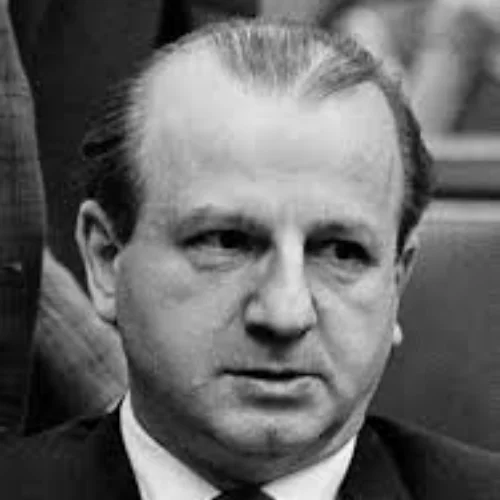
1911 - 1967
Summary
Name:
Jacob Leon RubensteinNickname:
SparkyYears Active:
1963Birth:
March 25, 1911Status:
DeceasedClass:
MurdererVictims:
1Method:
ShootingDeath:
January 03, 1967Nationality:
USA1911 - 1967
Summary: Murderer
Name:
Jacob Leon RubensteinNickname:
SparkyStatus:
DeceasedVictims:
1Method:
ShootingNationality:
USABirth:
March 25, 1911Death:
January 03, 1967Years Active:
1963Date Convicted:
March 14, 1964“I wouldn’t have done it if I did not have to do it.”
— Jacob Leon Rubenstein
Jack Ruby was born Jacob Leon Rubenstein on March 25, 1911, in Chicago, Illinois. His parents, Joseph Rubenstein and Fannie Turek, were Polish immigrants who followed the customs of Orthodox Judaism. Joseph, born in 1871, was a carpenter who served in the Russian army but grew unhappy with military life and eventually left. The family moved to the United States in 1903, settling in a Jewish neighborhood in Chicago.
Jack was the fifth of eight children in the Rubenstein family. His early life was troubled, marked by family strife and financial difficulties. His father struggled with alcohol, which led to a stressful home environment. By the time Jack was ten, his parents separated due to ongoing conflict, mainly stemming from his father's drinking and his mother’s strong personality.
Jack's upbringing included time spent in foster homes after the authorities intervened. In 1923, a court ruled the Rubenstein children needed proper care, leading to their placement in several homes. The family faced a significant lack of stability and discipline, which affected Jack throughout his youth.
As a child, Jack was known for his entrepreneurial spirit, making money by selling horse-racing tip sheets and other novelties on the streets. He had a few run-ins with the law during his teenage years, including issues with ticket scalping.
After completing eighth grade, Jack Ruby did not continue his education and instead worked various small jobs. By the late 1930s, he was involved with labor unions and made headlines when he was cleared in a shooting incident linked to union activities.
During World War II, Ruby was drafted and served as an aircraft mechanic in the Army Air Forces. After being discharged, he returned to Chicago, where he continued to explore various business ventures. In 1947, he relocated to Dallas, Texas, where he and his brothers changed their surname from Rubenstein to Ruby.
In Dallas, Ruby managed several nightclubs and developed connections with local police and figures in organized crime. His personality often led to conflicts, but he was known for his charisma and ability to make friends.
On November 24, 1963, Jack Ruby shot and killed Lee Harvey Oswald in the basement of the Dallas Police Headquarters. Oswald had been arrested for the assassination of President John F. Kennedy just two days earlier. At 11:21 AM, as Oswald was being transferred to a nearby jail, Ruby approached him in a crowd of reporters and fired his snub-nosed Colt Cobra .38 revolver into Oswald's abdomen, fatally wounding him. The shooting occurred just before Oswald was to be placed in an armored car.
The entire incident was broadcast live on television, marking the first time a homicide was witnessed by millions of viewers in real-time. Ruby was arrested immediately after the shooting and expressed several motives for his actions. Initially, he told witnesses that he wanted to spare Jacqueline Kennedy the pain of having to attend Oswald's trial and that he wanted to redeem Dallas's reputation in the eyes of the world by killing Oswald. Later, he claimed that the act was impulsive, done on a whim as the opportunity arose.
Ruby was taken into custody and quickly became a subject of intense media scrutiny. The police were puzzled about how he managed to get a gun into the supposedly secure area of the police station. It was noted that Ruby had a close relationship with several members of law enforcement, which added to the speculation about the ease of his access.
As investigations unfolded, theories emerged about Ruby's connection to organized crime. Some suggested that Ruby might have been acting on mob orders to prevent Oswald from testifying. However, his friends and associates generally described him as emotionally volatile, and some doubted that he would have been entrusted with a task of such significance within a conspiracy.
In March 1964, Jack Ruby was convicted of murder with malice and sentenced to death. He continued to maintain that he acted alone, initially wanting to convey a moral message through his actions. Ruby's conviction was appealed due to claims that he did not receive a fair trial, considering the immense public attention surrounding the case.
While awaiting his new trial, Ruby was diagnosed with cancer. He died on January 3, 1967, in Parkland Hospital, the same place where both Oswald and President Kennedy had been pronounced dead. Ruby was buried in Westlawn Cemetery in Chicago, and speculation about his motives and connections continues to intrigue many.
