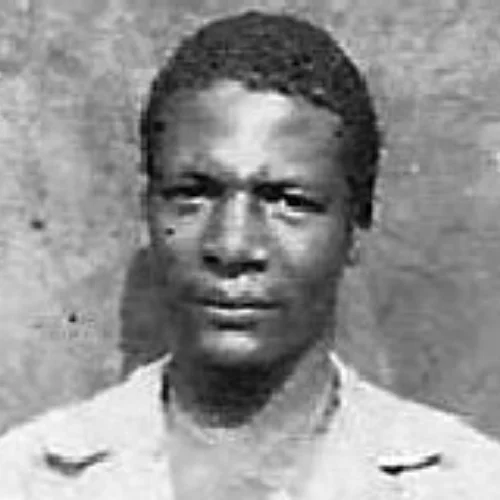
1922 - 1945
Summary
Name:
Herman PerryNickname:
Jungle KingYears Active:
1944Birth:
May 16, 1922Status:
ExecutedClass:
MurdererVictims:
1Method:
ShootingDeath:
March 15, 1945Nationality:
USA1922 - 1945
Summary: Murderer
Name:
Herman PerryNickname:
Jungle KingStatus:
ExecutedVictims:
1Method:
ShootingNationality:
USABirth:
May 16, 1922Death:
March 15, 1945Years Active:
1944Date Convicted:
September 4, 1944“You got me.”
— Herman Perry
Herman Perry was born on May 16, 1922, just outside Monroe, North Carolina. He grew up in a family that included several siblings. As a young man, Herman was known to be charming and liked to socialize. He enjoyed spending time with girls and going out to dance. His younger brother, Aaron, became a successful boxer, but Herman was more interested in romance than sports.
Herman’s life changed when he was drafted into the U.S. Army during World War II. He became a member of the 849th Engineer Battalion. This battalion was part of the China-Burma-India Theater, where soldiers worked on building the Ledo Road. This road was important for transporting supplies to help Allied forces in China. Herman and his fellow soldiers faced difficult conditions, including harsh weather, disease, and tough labor. Many men in his unit complained about the lack of proper treatment and food, and they felt mistreated because they were African American.
Perry had a troubled time in the Army. He often faced disciplinary actions, and he had already served time in the Ledo Stockade, a military prison known for its brutal conditions. During his time in the prison, he suffered from poor hygiene and health issues. After he served his sentence, he returned to his unit but struggled with the harsh realities of military life.
In March 1944, Perry's situation became dire. He had been using drugs like opium and marijuana to cope with the stress of his environment. On March 5, 1944, after missing morning roll call, he was confronted by Lieutenant Harold Cady, who sought to arrest him. Perry, fearing another harsh punishment and a return to the stockade, refused to surrender his rifle. In a moment of panic and fear, he shot the lieutenant and then fled into the jungle, marking the beginning of a manhunt that would last many months.
After fleeing, Perry spent time in the jungle, where he encountered a group of Naga tribesmen. He adapted to their way of life and, during this time, he married the chief's daughter. This life offered him a strange sense of peace compared to his experiences in the Army. However, it did not last, and he would be hunted down for his actions eventually.
On March 3, 1944, Herman Perry, a soldier in the U.S. Army, shot and killed Lieutenant Harold Cady. Cady was trying to arrest Perry for not following orders related to a military prison. Perry warned Cady to stay back while holding his rifle, but when Cady approached, Perry fired, hitting him twice. Afterward, Perry fled into the jungle.
Perry escaped into the Patkai Mountains, an area rich with dense jungle. For months, he survived in the wilderness, evading capture while living with the Naga tribes, known for their headhunting practices. The military launched a manhunt for Perry, offering a reward for his capture, either dead or alive.
Despite several efforts by military police to find Perry, he managed to escape twice when caught. He was eventually wounded and captured on July 20, 1944. Following his capture, he was tried by a military court and found guilty of murder. The court sentenced him to death by hanging.
Perry spent months in a military stockade, waiting for his sentence to be carried out. During this time, he attempted another escape before he was finally recaptured. His final capture occurred on March 9, 1945. He was executed by hanging on March 15, 1945, in Ledo, India.
