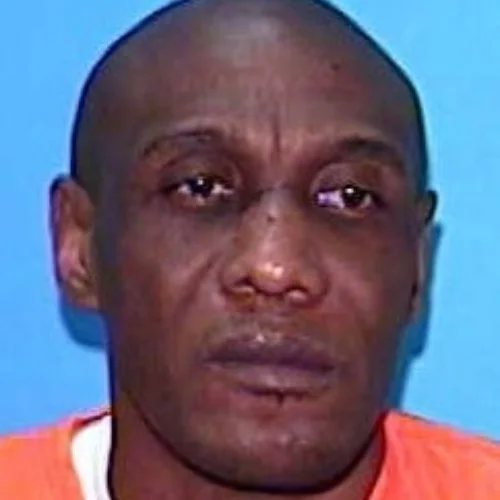
b: 1959
Summary
Name:
Harry JonesYears Active:
1991Birth:
September 04, 1959Status:
Awaiting ExecutionClass:
MurdererVictims:
1Method:
DrowningNationality:
USAb: 1959
Summary: Murderer
Name:
Harry JonesStatus:
Awaiting ExecutionVictims:
1Method:
DrowningNationality:
USABirth:
September 04, 1959Years Active:
1991Date Convicted:
November 13, 1992Harry Jones was born on September 4, 1959, in the United States, Jones grew up in circumstances that later court proceedings described as unstable. During post-conviction hearings, family members provided some of the few available details about his childhood. Testimony indicated that his father was physically abusive toward his mother during Jones' early years.
Despite the turmoil within the household, Jones reportedly formed a close attachment to his father. According to his older sister, he struggled emotionally when his father left the family when Jones was around five years old. Although these family experiences were introduced during later legal proceedings, court records did not establish any formal psychiatric diagnoses during his childhood, nor did they draw a direct connection between those events and the crimes he would later commit.
As Jones grew older, he developed an extensive criminal history that brought him repeatedly into contact with Florida's justice system. His first known felony offense occurred in the mid-1970s. Records from the Florida Department of Corrections show that he committed grand theft on August 14, 1976, and was sentenced on October 27, 1977, to eight years in prison. After his release, Jones returned to criminal activity. In 1981, he committed two separate robberies involving a firearm or deadly weapon.
The offenses occurred on September 22, 1981, and October 27, 1981, and both resulted in convictions and three-year prison sentences imposed on September 20, 1982. His involvement in violent crimes continued when he committed another robbery with a firearm or deadly weapon on December 24, 1983. For that offense, he was sentenced on April 13, 1984, to five years' imprisonment. These repeated convictions demonstrated a long-standing pattern of theft-related crimes that increasingly involved the threat or use of violence.
Despite spending years within the correctional system, little verified information has emerged regarding Jones' education, employment history, romantic relationships, or other aspects of his adult life outside of his criminal record. Public records and court documents remain largely silent on how he supported himself following his releases from prison or whether he maintained stable personal relationships during that period.
Evidence presented during his later murder trial also revealed that alcohol played a significant role in the events leading up to the killing of George Wilson Young Jr. Jones testified that he had spent much of the night of May 31, 1991, drinking with Timothy Hollis and continued consuming alcohol into the following day. After the incident that resulted in Young's death, Jones was involved in a vehicle crash while driving the victim's truck. Medical records introduced at trial showed that his blood alcohol concentration measured 0.269 percent when he was treated at the hospital that evening, a level indicating severe intoxication.
On the evening of June 1, 1991, 54-year-old George Wilson Young Jr. stopped at a liquor store on the west side of Tallahassee, Florida, where he spoke with his friend, Archie Hamilton, an employee at the store. Around the same time, Harry Jones entered the establishment accompanied by Timothy Hollis, who appeared heavily intoxicated and physically ill. Jones escorted Hollis to the restroom, and upon returning, Hamilton noticed Jones watching as Young paid cash for a half-pint of gin. After Hollis became sick, Young assisted Jones in helping him outside. Young then agreed to give both men a ride in his red Ford Bronco II.
Several witnesses later testified that the three men left the liquor store shortly before 7:00 p.m. Hollis' mother later recalled that Jones and an older white-haired man, later identified as Young, brought Hollis home before leaving together in Young's vehicle. A clerk at a nearby convenience store also reported seeing Jones and Young together between 7:30 p.m. and 8:00 p.m., when they purchased a six-pack of beer.
At approximately 8:05 p.m., Young's Ford Bronco II was involved in a traffic accident on the north side of Tallahassee. Emergency responders found Harry Jones as the sole occupant of the vehicle, and he was transported to a local hospital for treatment. When investigators learned that the registered owner of the vehicle was missing, detectives questioned Jones about how he came to possess the truck. Jones claimed that he had paid twenty dollars to borrow it from an unidentified man in Tallahassee's Frenchtown neighborhood.
As investigators continued to piece together Young's final hours, witnesses placed Jones in Young's company shortly before the crash. The following day, officers returned to the hospital and obtained clothing that had been removed from Jones by medical personnel. They also collected lottery tickets and cash that hospital security had recovered from Jones' pockets.
The investigation took a more serious turn on June 6, 1991, when George Young's body was discovered floating in Boat Pond on Horseshoe Plantation in northern Leon County, Florida. Individuals who found the body told investigators that they had previously seen Jones fishing at ponds on the same property. Forensic testing strengthened the connection between Jones and the crime scene. Soil and pollen samples recovered from Jones' clothing were consistent with samples collected from the area surrounding Boat Pond. Investigators also determined that lottery tickets found in Jones' possession had been purchased at the same time and location as tickets discovered inside Young's vehicle.
The medical examiner concluded that freshwater drowning was the cause of George Young's death. Plant material found deep within Young's throat and lungs established that he had been alive when submerged in the pond. The autopsy also documented a fractured arm and several broken ribs, injuries that were consistent with a violent struggle before death. Although the medical examiner could not determine whether Young remained conscious as he entered the water, the evidence demonstrated that he was breathing when he drowned.
While awaiting trial, Jones allegedly made incriminating statements to fellow inmates housed with him. Inmate Kevin Prim testified that Jones admitted targeting Young after noticing that he was carrying cash. According to Prim, Jones described attempting to rob Young near the pond and said that when Young resisted, a struggle followed. Prim testified that Jones stated he had broken Young's arm and held him underwater until he stopped resurfacing. Another inmate, Jay Watson, corroborated parts of Prim's testimony by stating that he overheard Jones acknowledge killing a man while discussing the reason for his incarceration.
A Leon County grand jury indicted Harry Jones on July 18, 1991, charging him with First-Degree Murder, Robbery, and Grand Theft of a Motor Vehicle. His first trial ended without a verdict after jurors were unable to reach a unanimous decision, resulting in a mistrial. A second trial was later held in November 1992.
On November 13, 1992, the jury found Jones guilty on all charges. Following the penalty phase, jurors recommended a sentence of death by a 10-to-2 vote. On November 20, 1992, Circuit Judge William Gary formally sentenced Jones to death for the murder of George Young. He also received a 30-year prison sentence for robbery and a 10-year sentence for grand theft of a motor vehicle.
Jones pursued a series of appeals following his conviction. He filed a direct appeal on November 30, 1992, arguing, among other issues, that evidence had been improperly admitted at trial and that jurors had been exposed to prejudicial photographs. On November 10, 1994, the Florida Supreme Court rejected those claims and affirmed both his convictions and death sentence. Jones then sought review before the United States Supreme Court, filing a petition for a writ of certiorari on April 21, 1995. The petition was denied on June 19, 1995.
In the years that followed, Jones pursued post-conviction relief through Florida Rule of Criminal Procedure 3.850. His motion was filed on March 21, 1997, and denied by the circuit court on September 23, 2005. Additional state and federal appeals, including habeas corpus proceedings, were subsequently filed. However, courts consistently denied relief and upheld both his conviction and sentence.
Harry Jones remains on Florida's Death Row under a sentence of death for the murder of George Wilson Young Jr. No execution date has been scheduled.
