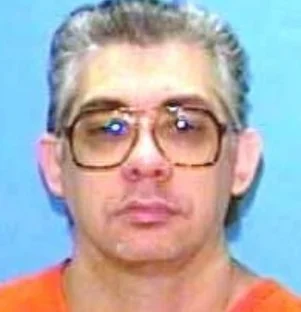
b: 1957
Summary
Name:
George Michael HodgesYears Active:
1987Birth:
August 15, 1957Status:
Awaiting ExecutionClass:
MurdererVictims:
1Method:
ShootingNationality:
USAb: 1957
Summary: Murderer
Name:
George Michael HodgesStatus:
Awaiting ExecutionVictims:
1Method:
ShootingNationality:
USABirth:
August 15, 1957Years Active:
1987Date Convicted:
February 22, 1989George Michael Hodges was born on August 15, 1957. Court records developed during his later appeals note that he grew up in an impoverished area and had a brief and troubled record of military service, he was discharged after only 55 days, with internal military documents attributing the discharge to "unsuitability" and describing him as having a "defective attitude" and being "unable to adjust to a disciplined environment." At the time of the murder, Hodges worked on the maintenance crew of a department store in Plant City, Florida, located across the road from a convenience store where 20-year-old Betty Ricks worked as a clerk.
In November 1986, Plant City police arrested Hodges for indecent exposure based on a complaint filed by Ricks. Court records indicate Hodges made efforts to persuade Ricks to drop the charges, but she remained adamant about proceeding with the prosecution.
On the morning of January 8, 1987, the same day Hodges's indecent exposure charge was scheduled for a criminal diversion program arbitration hearing, Betty Ricks was found lying next to her car in the convenience store's parking lot at around 6:00 a.m. She had been shot twice, in the head and neck, with a rifle, and died the following day without regaining consciousness.
A coworker told police she had seen Hodges's truck at the convenience store around 5:40 a.m. that morning. Hodges claimed he had been home asleep at the time, since he was not scheduled to work that day; his wife and stepson, Jesse Watson, initially supported this alibi.
The case against Hodges built slowly over roughly two years. According to trial testimony, Watson's girlfriend stated that in the summer of 1988, she asked Hodges whether he had ever shot anyone, and he told her he had shot a girl, that he had given Watson's rifle to police to deflect suspicion, and that he had disposed of his own rifle. At trial, both Hodges's wife and his stepson gave testimony that contradicted their earlier statements to police — his wife acknowledged she did not actually know whether Hodges had been home all night, and both she and Watson admitted that Hodges and Watson owned identical rifles, raising the possibility that the rifle turned over to police was not the murder weapon. Watson further testified that he had woken before 6:00 a.m. on the morning of the murder to hear Hodges arrive home by truck and enter the house carrying a rifle, and that he had originally concealed this to protect Hodges. Watson also stated that, roughly two months after the murder, he saw a rifle wrapped in plastic in the back of Hodges's truck, along with a freshly dug hole near a toolshed on the property, and that Hodges later confessed the killing to him directly.
Hodges was formally charged with first-degree murder on February 22, 1989, and pleaded not guilty. His trial began July 10, 1989; the jury found him guilty of first-degree murder and recommended a death sentence, which the trial court imposed on August 10, 1989. The trial court found that Hodges had committed the murder specifically to prevent Ricks from proceeding with the indecent exposure prosecution, and that the killing had been carried out in a cold, calculated, and premeditated manner, including lying in wait for the victim and constructing an elaborate alibi and cover story afterward.
The Florida Supreme Court affirmed both the conviction and the death sentence on direct appeal in 1992. The U.S. Supreme Court subsequently granted certiorari, vacating and remanding the case for further consideration in light of its decision in Espinosa v. Florida, a ruling concerning unconstitutional jury instructions in Florida capital sentencing. On remand, the Florida Supreme Court again affirmed Hodges's death sentence in 1993.
Hodges has since pursued extensive post-conviction and federal habeas litigation, arguing in part that his trial counsel failed to adequately investigate and present mitigating evidence from his school, military, and medical records, and that testimony regarding Ricks's own statements about pursuing the indecent exposure charge, along with her sister's emotional trial testimony, improperly prejudiced the jury. The Florida Supreme Court denied his postconviction claims in 2004, and the U.S. Court of Appeals for the Eleventh Circuit denied habeas relief in 2007, finding that even without the disputed testimony, the evidence of Hodges's guilt, including his confessions to two separate witnesses, a witness placing his truck at the scene, and the contradictions in his alibi was strong. Records indicate Hodges attempted suicide at some point while in custody, prompting a competency evaluation before sentencing.
George Michael Hodges remains on Florida's death row as of the most recent available reporting, more than three decades after his conviction.
