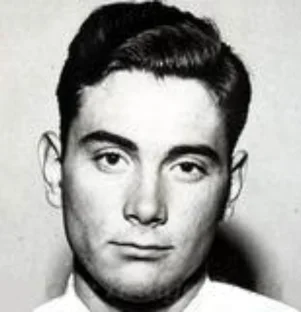
Summary
Name:
Fred Eugene McManusYears Active:
1953Status:
ReleasedClass:
Serial KillerVictims:
5Method:
ShootingNationality:
USASummary: Serial Killer
Name:
Fred Eugene McManusStatus:
ReleasedVictims:
5Method:
ShootingNationality:
USAYears Active:
1953Date Convicted:
September 24, 1953“I was in love and I needed money.”
— Fred Eugene McManus
Fred Eugene McManus was born in 1935 and raised in Valley Stream, Long Island, New York, in a stable and financially comfortable household. His father worked as a brewery executive, and McManus was the eldest of three children.
He was generally described as polite, quiet, and well-mannered, with no known history of criminal behavior during his youth. He attended local schools, participated in junior varsity football, and was considered responsible within his community.
After graduating from high school in 1952, McManus enlisted in the United States Marine Corps instead of attending college, a decision that reportedly caused conflict within his family. He was later assigned clerical duties, which he found unsatisfactory.
Prior to his enlistment, he had met Diane Marie Weggeland, a 16-year-old girl. In March 1953, while on leave, he reunited with her in Rochester, New York. The couple decided to marry and, believing they could do so without parental consent in Minnesota, planned to travel there despite having limited money—circumstances that preceded the crimes that followed.
The series of murders committed by Fred Eugene McManus occurred over a four-day period between March 27 and March 30, 1953, spanning multiple states.
On March 27, 1953, in the Rochester, New York area, McManus began the spree by targeting 19-year-old college student William Braverman. After obtaining a ride from Braverman, McManus used a .45 caliber firearm to rob him. When Braverman resisted the theft of his vehicle, McManus shot him, resulting in his death. McManus then concealed the body in a gravel pit and took possession of the victim’s car.
After reuniting with Weggeland, McManus traveled west. On March 28, 1953, he arrived in Keeneyville, Illinois, where he entered a small grocery store owned by George Bloomberg, aged 56, and his wife Florence Bloomberg. During an attempted robbery, McManus shot George Bloomberg after a brief confrontation. Florence Bloomberg was also shot and killed when she reacted to the incident. McManus fled the scene without obtaining any money.
The following day, March 29, 1953, McManus committed a robbery in Dubuque, Iowa. During this incident, he took a small amount of money from another couple but did not kill them. He subsequently abandoned the previously stolen vehicle and acquired another car.
On March 30, 1953, McManus arrived in Spring Valley, Minnesota. He entered a restaurant and carried out another robbery. During this crime, he shot and killed Harriet Horseman, a 48-year-old waitress, and Agnes Beaston, the 43-year-old wife of the establishment’s owner. He obtained approximately $40 to $50 from the register before leaving the scene.
Following the Minnesota murders, McManus and Weggeland traveled to Minneapolis with the intention of marrying. However, they were informed that a waiting period was required before a marriage license could be issued. The pair then began traveling back toward Iowa.
On March 31, 1953, law enforcement officers stopped the vehicle near Dubuque, Iowa. McManus was taken into custody without significant resistance. Weggeland was also detained but was later determined not to have participated in the killings.
After his arrest, McManus waived extradition and was returned to New York. On April 6, 1953, he formally confessed to the murder of William Braverman. Authorities in Illinois and Minnesota also linked him to the additional killings in those states.
McManus was charged and tried in New York for the Braverman murder. Initially entering a guilty plea, he later changed his plea to not guilty by reason of insanity. During the trial, prosecutors presented evidence of the cross-state killings and McManus’ own statements describing the crimes.
On September 24, 1953, he was found guilty of murder. Two days later, on September 26, 1953, he was sentenced to life imprisonment. The jury recommended leniency, which resulted in a life sentence rather than capital punishment.
Although he was connected to multiple murders across four states, New York retained jurisdiction for prosecution, and other states did not pursue additional trials. McManus ultimately served approximately 20 years in prison. He was released in 1973 and later completed parole in 1981.
