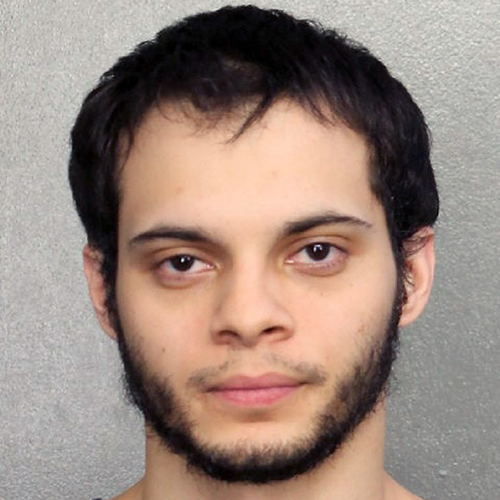
b: 1990
Summary
Name:
Esteban Santiago-RuizYears Active:
2017Birth:
March 16, 1990Status:
ImprisonedClass:
Mass MurdererVictims:
5Method:
ShootingNationality:
USAb: 1990
Summary: Mass Murderer
Name:
Esteban Santiago-RuizStatus:
ImprisonedVictims:
5Method:
ShootingNationality:
USABirth:
March 16, 1990Years Active:
2017Date Convicted:
May 23, 2018Esteban Santiago-Ruiz was born on March 16, 1990, in Union City, New Jersey, and moved to Peñuelas, Puerto Rico, at age two. He lived most of his early life in Puerto Rico, where he completed his high school education. On December 14, 2007, he joined the Puerto Rico National Guard and served in the Iraq War from April 23, 2010, to February 19, 2011, as a combat engineer. He later served with the Alaska Army National Guard from November 21, 2014, until his general discharge on August 16 (year unspecified), citing unsatisfactory performance. During his military service, Santiago received ten awards.
After his time in the military, Santiago experienced growing mental health issues. His family reported that his symptoms worsened after witnessing a bomb explosion that injured two friends during his Iraq deployment. He later received psychological treatment. In 2012, Puerto Rican police investigated his erratic behavior and temporarily confiscated his firearms, returning them in 2014. He obtained a Florida driver’s license and moved to Alaska that same year.
In Alaska, Santiago worked for a private security company, Signal 88 Security, but was dismissed in November 2016 due to concerns about his mental health. That same month, he visited an FBI office in Anchorage, claiming the CIA was controlling his mind and forcing him to watch Islamic State videos. He also claimed to hear voices urging him to commit violence. The FBI advised him to seek mental health care and referred him to local authorities, who admitted him for evaluation. However, no legal basis was found to continue detaining him, and his firearm—previously confiscated—was returned.
In January 2016, Santiago was charged with domestic violence for assaulting his girlfriend in Anchorage. The case ended in a deferred prosecution agreement, and a temporary protection order expired without further court action. He had one son and remained unemployed at the time of the Fort Lauderdale shooting.
On January 6, 2017, Esteban Santiago-Ruiz flew from Anchorage, Alaska, to Fort Lauderdale, Florida, with a layover in Minneapolis. He legally transported a Walther PPS 9mm semi-automatic pistol, declared and secured in his checked baggage. Upon arrival at Fort Lauderdale–Hollywood International Airport, he retrieved his luggage, entered a bathroom in Terminal 2, assembled the weapon, and loaded it.

At 12:53 p.m. EST, Santiago exited the restroom and began firing in the baggage claim area of Terminal 2, which serves Delta Air Lines and Air Canada. He discharged 15 rounds during the 70–80 second attack, killing five individuals and injuring six others by gunfire. An additional 30 to 40 people sustained injuries during the resulting panic. Santiago surrendered by lying on the ground and was apprehended within 85 seconds by a Broward County Sheriff’s deputy. Law enforcement did not discharge any weapons during the arrest.
The shooting resulted in a shutdown of the airport for the remainder of the day. President Obama and President-elect Donald Trump were both briefed. Florida Governor Rick Scott ordered U.S. and Florida state flags to be flown at half-mast on January 7 and 8, 2017. Approximately 10,000 passengers were relocated to Port Everglades, and more than 20,000 pieces of luggage were left behind amid the chaos.
Federal charges were filed the next day. Santiago was indicted on 22 counts, including performing acts of violence at an international airport and using a firearm to commit murder. He initially pleaded not guilty but later changed his plea as part of an agreement to avoid the death penalty. On May 23, 2018, Santiago pleaded guilty, and on August 17, 2018, he was sentenced to five consecutive life terms plus 120 years in federal prison. He was incarcerated at USP Allenwood and later transferred to USP Tucson.
