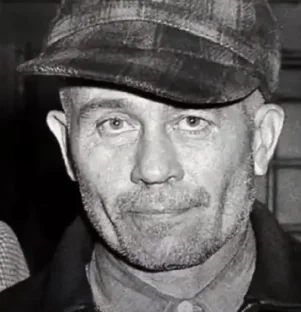
1906 - 1984
Summary
Name:
Edward Theodore GeinNickname:
The Plainfield Ghoul / The Butcher of PlainfieldYears Active:
1954 - 1957Birth:
August 27, 1906Status:
DeceasedClass:
MurdererVictims:
2+Method:
ShootingDeath:
July 26, 1984Nationality:
USA1906 - 1984
Summary: Murderer
Name:
Edward Theodore GeinNickname:
The Plainfield Ghoul / The Butcher of PlainfieldStatus:
DeceasedVictims:
2+Method:
ShootingNationality:
USABirth:
August 27, 1906Death:
July 26, 1984Years Active:
1954 - 1957Date Convicted:
November 14, 1968“Just as well.”
— Edward Theodore Gein
Edward Theodore Gein was born on August 27, 1906, in La Crosse County, Wisconsin, the younger of two sons of George Philip Gein, an alcoholic who was verbally and physically abusive toward his sons, and Augusta Wilhelmine Gein, a fanatically religious woman who dominated Ed's upbringing, teaching him that sex was sinful and that women, apart from herself, were inherently immoral.
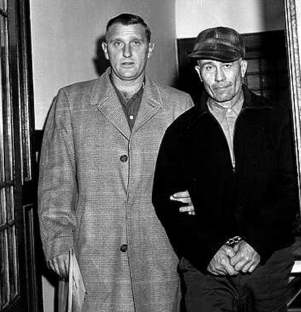
In 1914, the family moved to an isolated farm near Plainfield, Wisconsin. Gein's father died in 1940. His older brother, Henry, died in 1944 under circumstances that have drawn some speculation over the years — a fire while the two were burning brush near their property — though the death was ruled accidental and Gein was never charged.
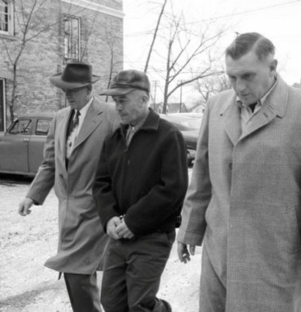
Augusta Gein died following a stroke on December 29, 1945, leaving Ed alone on the farm; psychiatric evaluators later identified her death as the catalyst for what they described as his complete emotional collapse. Gein sealed off his mother's bedroom, preserving it as a shrine, and lived in the kitchen and a single back room of the house, working locally as a quiet, reliable handyman while privately developing an obsession with anatomy texts, pulp horror stories, and death notices in local newspapers.
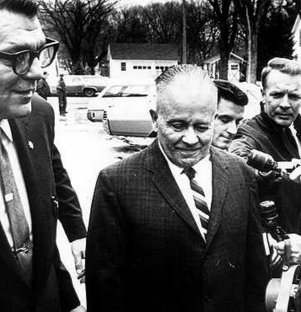
Between 1947 and 1952, Gein exhumed the graves of at least nine women from local cemeteries, selecting those who resembled his mother. He used their remains to craft an array of household items and clothing, including bowls made from skulls, a corset fashioned from human skin, face masks, and a full "woman suit" that he could wear.
On December 8, 1954, Mary Hogan, a tavern owner in the Plainfield area (reported as either 51 or 54 years old, depending on the source), disappeared; blood was found at the scene, but the case went cold with no immediate suspect.
On November 16, 1957, Bernice Worden, the 58-year-old owner of a Plainfield hardware store, disappeared. Her son, Deputy Sheriff Frank Worden, grew suspicious and found a sales receipt for antifreeze made out to Ed Gein among the store's paperwork; he recalled Gein had told his mother he would return to the store that morning. That evening, officers went to Gein's farmhouse, where they discovered Worden's body hanging upside down and decapitated in a shed, having been shot and eviscerated. Inside the house, they found her head inside a cardboard box, along with the head of Mary Hogan, and an extensive collection of household objects, furniture, and clothing fashioned from human remains, including a wastebasket made of skin and skulls mounted on bedposts.
Gein was arrested on November 17, 1957. During initial questioning, Sheriff Art Schley reportedly assaulted Gein, banging his head against a wall; as a result, Gein's initial confession was later ruled inadmissible in court. Schley himself died of heart failure in 1968, at age 43, before Gein's eventual trial; those who knew him believed he had been deeply traumatized by the case. Over subsequent interrogations, Gein admitted to killing both Hogan and Worden and to robbing at least nine graves for body parts. He was also investigated as a possible suspect in several other unsolved Wisconsin disappearances, including those of Georgia Jean Weckler, 8; Evelyn Grace Hartley, 14; and others, but polygraph testing and a lack of physical evidence led investigators and psychiatrists to conclude he had not been involved, and that his violence had been specifically directed at women who physically resembled his mother.
Gein was arraigned on November 21, 1957, on one count of first-degree murder in Waushara County Court, pleading not guilty by reason of insanity. He was diagnosed with schizophrenia and found mentally incompetent to stand trial, and was committed to the Central State Hospital for the Criminally Insane in Waupun, Wisconsin, on January 6, 1958. He was later transferred to the Mendota Mental Health Institute in Madison. Gein's farmhouse, which had drawn crowds of curiosity seekers, was destroyed by fire in 1958 under circumstances that were never resolved, though arson was widely suspected.
After nearly a decade of psychiatric treatment, doctors determined in 1968 that Gein was mentally competent to stand trial and participate in his own defense. His trial, presided over by Circuit Judge Robert H. Gollmar without a jury, began on November 7, 1968, and lasted about one week. Because of the significant cost of prosecuting multiple murders, Gein was tried only for the killing of Bernice Worden.
A psychiatrist testified that Gein claimed he did not know whether Worden's death had been intentional or accidental, describing a gun discharging while he examined it inside her store. On November 14, 1968, the court found Gein guilty of first-degree murder; in the immediately following sanity phase of the same proceeding, the court found him not guilty by reason of insanity, resulting in his commitment to a psychiatric institution rather than a prison sentence.
Gein spent the remainder of his life in psychiatric institutions, primarily the Mendota Mental Health Institute, where staff described him in later years as quiet, courteous, and almost childlike, engaging in occupational therapy and reading magazines. He died at Mendota on July 26, 1984, at age 77, of respiratory failure secondary to lung cancer. He is buried at Plainfield Cemetery between his parents and brother.
Over the years, souvenir hunters repeatedly chipped pieces from his headstone before the stone itself was stolen in 2000; it was recovered in 2001 near Seattle, Washington, and has since been kept in storage by the Waushara County Sheriff's Department, leaving his grave unmarked.
Despite having only two confirmed murder victims — fewer than the traditional threshold for a "serial killer" — Gein's case, and the extensive human-remains artifacts discovered in his home, had an outsized influence on American popular culture. He is widely credited as the inspiration for fictional killers including Norman Bates in Robert Bloch's 1959 novel Psycho (and its 1960 film adaptation), Leatherface in The Texas Chain Saw Massacre, and Buffalo Bill in The Silence of the Lambs. His story has also been the subject of numerous documentaries, including Netflix's Monster: The Ed Gein Story (2025).
