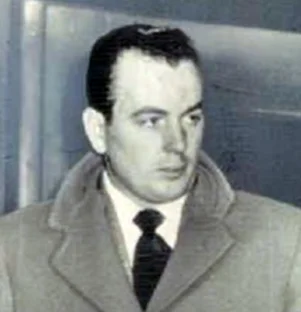
1924 - 1951
Summary
Name:
Edward Lester GibbsYears Active:
1950Birth:
December 01, 1924Status:
ExecutedClass:
MurdererVictims:
1Method:
BludgeoningDeath:
April 23, 1951Nationality:
USA1924 - 1951
Summary: Murderer
Name:
Edward Lester GibbsStatus:
ExecutedVictims:
1Method:
BludgeoningNationality:
USABirth:
December 01, 1924Death:
April 23, 1951Years Active:
1950Date Convicted:
March 16, 1950"I was sure nobody would be able to find it for a long, long time. I had an idea that when spring came and the ground softened up a little, I might come back and bury her. I didn't figure anyone would come around the cottage in the winter."
— Edward Lester Gibbs
Edward Lester Gibbs was born on December 1, 1924. By 1950, at age 25, he was a married World War II veteran who had served with the U.S. Army Air Force in Europe, and was an academically strong student at Franklin & Marshall College in Lancaster, Pennsylvania, living with his wife, Helen, in college housing. He was well regarded socially and academically, and had previously driven Marian Louise Baker, an employee of the college, to the bank on multiple occasions when she deposited canteen funds.
On the afternoon of January 10, 1950, Gibbs encountered Marian Baker, 21, a secretary at Franklin & Marshall College, on a downtown Lancaster street and offered to drive her back to campus. Rather than returning directly, the two drove out into the countryside and stopped near a vacant summer cottage (the Harnish cottage) along the Conestoga River, about two miles south of the city. There, Gibbs was suddenly overcome by what he described as a sudden impulse; he attacked Baker, beating her to death with a lug wrench. He took no sexual liberties with her but stole her rings and purse.
Overwhelmed by what he had done, Gibbs initially fled the scene, but returned within about an hour with a shovel, intending to bury her. Finding the ground too frozen to dig, he instead dragged her body into a hole beneath the cottage and covered it with sheets of corrugated metal roofing, hoping the concealment would hold until spring, when he thought he might return to properly bury her. Baker's watch had been smashed during the struggle and had stopped at 2:36 p.m., which investigators later used to establish the time of the attack.
Baker was reported missing on January 10, and a search alert went out across 13 states in the following days, though her clothing and belongings remained in her rooming house, suggesting she had not planned to leave the area. Her body was discovered under the cottage approximately four days later. During the initial investigation, Gibbs was questioned early on, having drawn suspicion due to a scratch on his cheek; he was cleared at the time when a fellow student confirmed having accidentally scratched him during basketball practice.
As investigators continued closing in — including following up on the alibi of another initial suspect — Gibbs, increasingly unable to maintain the deception, went to the office of Franklin & Marshall College President Theodore Distler, forcing his way past a secretary in a disheveled and emotional state. After sobbing and initially struggling to be believed, Gibbs gave a full confession, describing the crime in detail and offering to show investigators where he had hidden evidence. His stolen ring was later recovered from a drain trap, and a jacket stained with the victim's blood was found during a search of his dormitory residence. In his confession, when asked what he had done with Baker's purse, Gibbs said, "I threw it away. There was $14 in it. I took the money and spent it."
Gibbs's trial began March 14, 1950, drawing a crowd of roughly 300 people outside the Lancaster County Courthouse. He entered a plea of not guilty, and his defense centered on his mental state; Gibbs testified about wartime experiences that continued to haunt him and stated his memory of killing Baker "is not clear." His attorneys had him examined by Dr. Edward Strecker, a prominent psychiatrist and University of Pennsylvania professor, who testified that Gibbs was schizophrenic; Gibbs also underwent an electroencephalogram (EEG) scan in Philadelphia, a technology only recently introduced at the time. Under cross-examination, Strecker was asked whether Gibbs might kill again, and answered, "I think it is possible that he might. You couldn't be sure."
After five hours of deliberation, the jury returned its verdict on March 17, 1950, finding Gibbs guilty of first-degree murder and decreeing a sentence of death — the first time in Lancaster County history that a jury, rather than a judge, had determined a death sentence; the county's only prior capital case, in 1922, had been decided by a judge alone.
Gibbs's attorneys appealed his conviction, both locally and to the Pennsylvania Supreme Court, raising issues including the trial judge's jury instructions regarding the degree of murder and an alleged failure to properly instruct on the presumption of innocence. The Pennsylvania Supreme Court rejected these arguments and affirmed his conviction and sentence in Commonwealth v. Gibbs, 366 Pa. 182 (1950). With all appeals exhausted, Edward Lester Gibbs was executed by electrocution on April 23, 1951.
