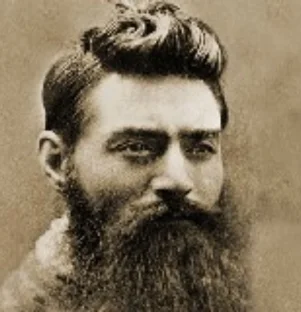
d: 1880
Summary
Name:
Edward KellyNickname:
NedYears Active:
1878 - 1880Status:
ExecutedClass:
MurdererVictims:
6Method:
ShootingDeath:
November 11, 1880Nationality:
Australiad: 1880
Summary: Murderer
Name:
Edward KellyNickname:
NedStatus:
ExecutedVictims:
6Method:
ShootingNationality:
AustraliaDeath:
November 11, 1880Years Active:
1878 - 1880Date Convicted:
October 28, 1880“Ah, well, I suppose it has come to this.” This is one of the commonly reported versions of his final words. State Library Victoria notes that most observers reported his last words as “ah well I suppose” or “ah well I suppose it has come to this.”
— Edward Kelly
Edward “Ned” Kelly was born at Beveridge, Victoria, in 1854 or 1855. He was the son of John “Red” Kelly, an Irish transported convict from County Tipperary, and Ellen Quinn Kelly. His father had been sent to Van Diemen’s Land after being convicted of stealing pigs and later moved to Victoria after his release. The Kelly family lived in rural Victoria, where poverty, land disputes, police attention, and suspicion of livestock theft shaped much of Ned Kelly’s early life.
Kelly grew up in a large Irish Australian family and received only basic schooling. As a boy, he was remembered for saving another child from drowning, an act for which he was reportedly given a green sash. He later wore that sash under his armour during the Glenrowan shootout in 1880.
After his father’s death in 1866, Kelly’s family struggled financially. They moved to the Greta area, later known as “Kelly Country.” Members of the family were repeatedly investigated or charged over cattle and horse theft, and Kelly later claimed that police had unfairly targeted his family. His early criminal record included accusations of assault, robbery, receiving a stolen horse, and involvement with bushranger Harry Power. He served time in prison as a teenager after being convicted in connection with a stolen horse.
The event that pushed Kelly fully into outlaw status was the Fitzpatrick incident in April 1878. Constable Alexander Fitzpatrick went to the Kelly home to arrest Dan Kelly on a horse-stealing warrant. Fitzpatrick later claimed that Ned Kelly shot him in the wrist and that Ellen Kelly and others helped attack him. Kelly denied being present and claimed Fitzpatrick’s account was false. Ellen Kelly, William Skillion, and William Williamson were convicted in connection with the incident. Ned and Dan Kelly then fled into the bush, where they were joined by Joe Byrne and Steve Hart.
On October 26, 1878, police searching for Ned and Dan Kelly camped at Stringybark Creek in Victoria. The police party included Sergeant Michael Kennedy and Constables Thomas Lonigan, Michael Scanlan, and Thomas McIntyre. Kelly, Dan Kelly, Joe Byrne, and Steve Hart approached the camp. McIntyre was unarmed and surrendered, but Lonigan moved for cover and was shot dead by Ned Kelly. When Kennedy and Scanlan returned to camp, more shots were fired. Scanlan was killed, and Kennedy was later shot after trying to escape. McIntyre survived and reported the killings.
After Stringybark Creek, the Victorian government declared the Kelly Gang outlaws under the Felons’ Apprehension Act. The law allowed the gang members to be shot on sight. Rewards were offered for their capture, and the Kelly Gang became the focus of a major police operation.
In December 1878, the gang robbed the National Bank at Euroa. In February 1879, they crossed into New South Wales and robbed the Bank of New South Wales at Jerilderie. During the Jerilderie robbery, Kelly attempted to have a long public letter published. This document, now known as the Jerilderie Letter, was dictated by Kelly to Joe Byrne and set out Kelly’s version of police persecution, family grievances, and his justification for violence. State Library Victoria describes it as a handwritten document that Kelly wanted published in the press.
On June 26, 1880, Joe Byrne and Dan Kelly killed Aaron Sherritt, a former associate who had been acting as a police informer. The killing was part of a larger Kelly Gang plan to draw police by train to Glenrowan. The gang then took hostages at the Glenrowan Inn and damaged the railway line, intending to derail a police train. The plan failed after schoolteacher Thomas Curnow warned the train crew before it reached the broken track.
On June 28, 1880, police surrounded the Glenrowan Inn. Ned Kelly appeared outside wearing homemade metal armour and exchanged gunfire with police. His armour protected his torso and head, but his legs were exposed. He was wounded and captured. Joe Byrne was killed during the siege. Dan Kelly and Steve Hart died inside the inn after it was set on fire. Hostage Martin Cherry was also fatally wounded, and 11-year-old John Jones died the next day from injuries suffered during the gunfight.
Kelly was taken into custody and later tried in Melbourne. On October 28, 1880, he was convicted of the wilful murder of Constable Thomas Lonigan. Justice Redmond Barry sentenced him to death. Public petitions were submitted asking that his life be spared, but the sentence was carried out.
Edward “Ned” Kelly was hanged at Old Melbourne Gaol on November 11, 1880.
