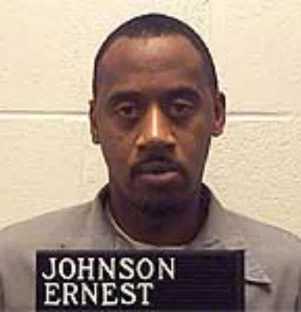
1963 - 2021
Summary
Name:
Earnest Lee JohnsonYears Active:
1994Birth:
August 20, 1963Status:
ExecutedClass:
Mass MurdererVictims:
3Method:
Bludgeoning / Stabbing / ShootingDeath:
October 05, 2021Nationality:
USA1963 - 2021
Summary: Mass Murderer
Name:
Earnest Lee JohnsonStatus:
ExecutedVictims:
3Method:
Bludgeoning / Stabbing / ShootingNationality:
USABirth:
August 20, 1963Death:
October 05, 2021Years Active:
1994Date Convicted:
May 19, 1995“I am sorry and have remorse for what I do.”
— Earnest Lee Johnson
Ernest Lee Johnson was born on August 20, 1960. He lived in Missouri and had a long history of substance abuse and criminal activity before the murders. Available court records show that he had prior convictions before the 1994 case, including burglary, stealing a motor vehicle, robbery, attempted burglary, and another burglary conviction.
Johnson struggled with cocaine addiction before the murders. Evidence presented during later court proceedings described him as a long-term drug user who was using crack cocaine around the time of the crime. His defense later argued that his drug use, intellectual limitations, and later medical condition should be considered in relation to his death sentence.
Before the murders, Johnson was a frequent customer at the convenience store where the victims worked. In January 1994, he reportedly told Rodriguez Grant that he planned to rob the store. His plan involved locking employees in a back room and forcing one employee to open the safe.
On February 12, 1994, Ernest Lee Johnson visited a Columbia, Missouri, convenience store several times. During one visit, he asked who would be working the next shift and learned that Mabel Scruggs would come in at 5:00 p.m. and that the store would close at 11:00 p.m.
Later that day, Johnson went to his girlfriend’s house and bought crack cocaine from her son, Rodriguez Grant. He also borrowed a .25-caliber pistol that he had previously traded to Rodriguez in exchange for drugs. Johnson and Rodriguez test-fired the weapon. Johnson later returned the gun, saying it did not work, but then retrieved it again before leaving the house wearing layered clothing, a mask, and black tennis shoes.
Around 11:45 p.m., Johnson returned to the house from the direction of the convenience store. His face and clothes were spattered with blood. He gave the pistol back to Rodriguez, cleaned his shoes, removed his clothing, and placed the clothes in a trash bag. He told Antwane Grant to get rid of the bag. Johnson also had a large amount of money, which he and Rodriguez counted before Johnson hid it in an air vent.
Early the next morning, at about 1:12 a.m. on February 13, 1994, a deputy sheriff responded to the convenience store after a report of a possible disturbance involving weapons. The store lights were still on. Through the windows, the officer saw the cash register open and the money vault on the floor. Blood was visible on the front door lock.
Police entered the store and found two bodies in the bathroom and another body inside the walk-in cooler. The safe was empty. The victims were identified as Mary Bratcher, Fred Jones, and Mabel Scruggs. Each died from severe head injuries consistent with a bloody hammer found at the scene. Mary Bratcher also had stab wounds to her hand consistent with a screwdriver, and Fred Jones had a nonfatal facial gunshot wound.
Investigators later found bloody clothing and other evidence connected to Johnson. Blood and hair evidence linked items recovered near the store and at Johnson’s girlfriend’s house to the victims. Police also recovered money, coin wrappers, burned store documents, a live .25-caliber bullet, and black tennis shoes matching bloody shoeprints from inside the store.
Johnson was arrested after giving inconsistent statements to police. When he saw Rodriguez Grant in a holding cell, Johnson said the boy had nothing to do with the crime. When asked how he knew that, Johnson replied that he knew they were not there.
Johnson was tried in Boone County, Missouri, in 1995. A jury convicted him of three counts of first-degree murder. On June 20, 1995, he was sentenced to death for each murder.
In 1998, the Missouri Supreme Court affirmed Johnson’s convictions but vacated the death sentences because of problems with the penalty phase. The case was sent back for a new sentencing proceeding. Johnson was later resentenced to death.
Johnson continued appealing his case for many years. His attorneys argued that he had intellectual disability and later raised concerns about his medical condition after brain surgery. In 2008, Johnson underwent surgery to remove a brain tumor, and his attorneys later argued that lethal injection could trigger severe seizures. Courts rejected his final claims, and Missouri Governor Mike Parson declined to grant clemency.
Ernest Lee Johnson was executed by lethal injection at the state prison in Bonne Terre, Missouri, on October 5, 2021. He was pronounced dead at 6:11 p.m. He was 61 years old.
