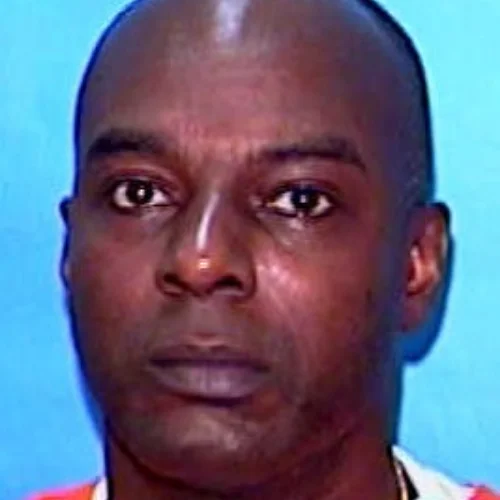
b: 1955
Summary
Name:
Clarence James JonesYears Active:
1988Birth:
March 09, 1955Status:
Awaiting ExecutionClass:
MurdererVictims:
1Method:
ShootingNationality:
USAb: 1955
Summary: Murderer
Name:
Clarence James JonesStatus:
Awaiting ExecutionVictims:
1Method:
ShootingNationality:
USABirth:
March 09, 1955Years Active:
1988Date Convicted:
September 22, 1989Clarence James Jones was born on March 9, 1955. Before arriving in Florida, Jones had accumulated a serious criminal history in Maryland. At the time of the events that led to his capital conviction, he was a known escapee from a Maryland prison. Records indicate that he had been serving three concurrent twenty-five-year sentences for three counts of robbery with a deadly weapon, along with a concurrent five-year sentence for attempted robbery with a deadly weapon.
After escaping from prison, Jones traveled with fellow escapees Henry Goins and Irvin Griffin. Accompanying the group was Beverly Harris, a woman who had been traveling with them. Their movements eventually brought them to Tallahassee, Florida, where events on July 8, 1988, resulted in the death of a police officer and Jones's placement on Florida's death row.
During the early morning hours of July 8, 1988, Tallahassee Police Officers Ernest Ponce de Leon and Greg Armstrong responded to a report concerning a suspicious vehicle parked behind a laundromat in Leon County, Florida. Upon arriving at the scene, the officers encountered Clarence James Jones, Henry Goins, Irvin Griffin, and Beverly Harris seated inside the vehicle.
As Officer Armstrong examined driver's licenses and Officer Ponce de Leon attempted to conduct a computer check on the vehicle's registration, gunfire suddenly erupted. Officer Ponce de Leon was struck by two gunshots to the chest fired by one of the passengers inside the vehicle. Following the shooting, Officer Armstrong exchanged gunfire with the suspects.
During the chaos, Jones retrieved Officer Ponce de Leon's service weapon. Jones and Griffin then fled the scene on foot. Both men sustained gunshot wounds during the confrontation.
The two fugitives forced their way into a nearby residence in an effort to avoid capture. Law enforcement officers quickly surrounded the area, and Jones and Griffin were apprehended inside the home later that same day.
Officer Ernest Ponce de Leon died at the scene as a result of the gunshot wounds he sustained during the encounter. He had served as a police officer with the Tallahassee Police Department and was survived by his family and fellow officers.
Jones maintained throughout the proceedings that he was not the person who fired the fatal shots. In his own defense, he testified that an unidentified drug dealer who had met the group at the laundromat was responsible for killing Officer Ponce de Leon. The jury rejected this version of events.
On July 28, 1988, Jones was indicted on charges of first-degree murder, attempted first-degree murder, armed robbery with a firearm, armed burglary of a dwelling, and armed kidnapping. He was also charged separately by information with aggravated assault with a firearm.
Following trial proceedings before Judge Phillip J. Padavano in Leon County, the jury found Jones guilty on September 22, 1989, of all counts presented against him. Two days later, the armed kidnapping charge was dismissed by nolle prosequi.
On September 25, 1989, the jury recommended a sentence of death by a vote of 11 to 1. The following day, September 26, 1989, Jones was formally sentenced. He received the death penalty for first-degree murder, life imprisonment for attempted first-degree murder, life imprisonment for armed robbery with a firearm, life imprisonment for armed burglary of a dwelling, and a five-year sentence for aggravated assault with a firearm.
Jones pursued numerous appeals and post-conviction proceedings over the following decades. His direct appeal to the Florida Supreme Court challenged several evidentiary rulings, including the trial court's refusal to permit questioning regarding certain witnesses' prior criminal histories. On May 16, 1991, the Florida Supreme Court affirmed both his convictions and death sentence. The United States Supreme Court later denied review on October 7, 1991.
Subsequent post-conviction motions raised claims involving ineffective assistance of counsel, allegations that prosecutors withheld exculpatory evidence, constitutional challenges regarding aggravating circumstances, and later arguments concerning intellectual disability. In November 2004, the Florida Supreme Court relinquished jurisdiction to allow the trial court to determine whether Jones qualified as intellectually disabled and therefore ineligible for execution. On July 27, 2005, the circuit court denied that claim.
Jones continued pursuing both state and federal post-conviction remedies while remaining under a sentence of death.
