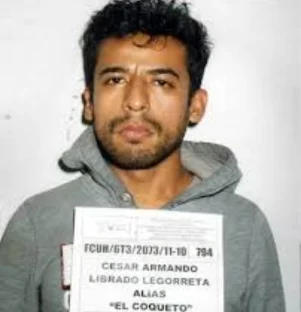
b: 1982
Summary
Name:
Cesar Armando Librado LegorretaNickname:
El Coqueto / The FlirtyYears Active:
2011 - 2012Birth:
June 16, 1982Status:
ImprisonedClass:
Serial KillerVictims:
6Method:
Strangulation / AsphyxiationNationality:
Mexicob: 1982
Summary: Serial Killer
Name:
Cesar Armando Librado LegorretaNickname:
El Coqueto / The FlirtyStatus:
ImprisonedVictims:
6Method:
Strangulation / AsphyxiationNationality:
MexicoBirth:
June 16, 1982Years Active:
2011 - 2012Date Convicted:
December 12, 2012“I raped eight women, of whom I killed seven because I was afraid they would report me.”
— Cesar Armando Librado Legorreta
Cesar Armando Librado Legorreta was born on June 16, 1982, in Mexico. Legorreta lived in the State of Mexico and worked as a public-transport driver. He drove a Route 2 microbus that traveled between Metro Chapultepec and Valle Dorado, connecting Mexico City and the State of Mexico.
His nickname, “El Coqueto,” means “The Flirty.” The nickname was linked to the way he spoke to women and acted around passengers and coworkers. His work as a driver gave him access to women traveling alone, especially late at night or early in the morning. He used his vehicle and route to isolate victims after other passengers had left.
Before the murders became widely known, several women disappeared or were found dead in areas such as Tlalnepantla, Naucalpan, and Cuautitlán Izcalli. The case later became widely discussed in Mexico because it showed serious failures in how disappearances and violence against women were investigated.
Between July 2011 and January 2012, Cesar Armando Librado Legorreta used his work as a public-transport driver to target women passengers in the Valley of Mexico area. He drove a Route 2 microbus on the Metro Chapultepec to Valle Dorado route. His crimes were committed in or around the vehicle he drove, and the bodies were later abandoned in public or isolated areas in municipalities in the State of Mexico.
His method was based on gaining control of a victim after she was alone. Reports state that he sometimes pretended the vehicle had mechanical trouble and asked other passengers to get off, leaving one woman behind. In other cases, he waited until the final female passenger remained on the bus. He then changed route, sexually assaulted the victim, killed her by asphyxiation or strangulation, and disposed of the body.
The crimes were eventually linked after repeated cases showed similar patterns. One surviving victim became important to the investigation. She reported the attack and helped identify him. Families of missing and murdered women also pushed authorities to investigate the Route 2 transport line more closely.
Legorreta was detained in February 2012, but the exact first detention date is disputed in public records. Some reports state that he was detained on February 18, 2012, while others list February 26, 2012. After being taken to the Tlalnepantla justice office, he escaped on February 27, 2012. Reports state that he got out through a window and suffered serious injuries after falling from the third floor.
After his escape, authorities launched a search and offered a reward for information leading to his capture. He was recaptured on March 3, 2012, in Magdalena Contreras, Mexico City. Reports state that he was injured and unable to move normally when authorities found him.
On December 12, 2012, a judge in the State of Mexico sentenced Legorreta to 240 years in prison for the rape and murder of six women. The sentence was calculated as 40 years for each victim. The court also ordered fines and compensation to the victims’ families.
The case became one of Mexico’s most widely known modern femicide cases. It drew attention not only because of the number of victims, but also because several families had already reported disappearances and believed authorities did not act quickly enough. The sentencing brought legal punishment for the confirmed cases, but relatives and women’s-rights advocates continued to point to failures in the investigation process.
Legorreta remained imprisoned and was transferred from Barrientos to another prison because of security concerns. A 2024 Milenio report listed him as imprisoned at Centro Preventivo y de Readaptación Social Otumba Tepachico, though the most reliable court-sentence record remains the 2012 conviction and sentence.
