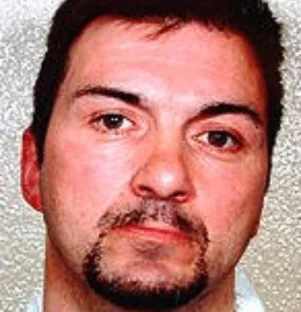
b: 1960
Summary
Name:
Barry GeorgeNickname:
Barry Bulsara / Paul Gadd / Steve Majors / Thomas PalmerYears Active:
1999Birth:
April 15, 1960Status:
ReleasedClass:
MurdererVictims:
1Method:
ShootingNationality:
United Kingdomb: 1960
Summary: Murderer
Name:
Barry GeorgeNickname:
Barry Bulsara / Paul Gadd / Steve Majors / Thomas PalmerStatus:
ReleasedVictims:
1Method:
ShootingNationality:
United KingdomBirth:
April 15, 1960Years Active:
1999Date Convicted:
July 2, 2001Barry Michael George was born in Hammersmith, London, on April 15, 1960. His parents divorced when he was 13, and at 14 he was sent to Heathermount, a publicly funded boarding school in Sunningdale, Berkshire, for children with emotional or behavioral difficulties. After leaving school without qualifications, his only period of employment was a four-month stint as a messenger for the BBC in 1977; his fascination with the BBC persisted for decades afterward, and he was a regular reader of the corporation's in-house magazine, Ariel, reportedly keeping several copies of the issue commemorating Jill Dando's murder. George developed an interest in celebrities, including Diana, Princess of Wales, and Prince Charles, and adopted a series of pseudonyms over the years, beginning at school, where he used the name Paul Gadd — the real name of singer Gary Glitter.
In 1980, after failing to join the Metropolitan Police, George posed as a police officer using forged warrant cards and was prosecuted; he appeared in court in glam-rock attire, falsely giving his name as Paul Gadd, and was fined £25 at Kingston Magistrates' Court. Separately that year, he was arrested twice — in March and August — on charges of indecent assault; at trial in June 1981, he was acquitted on one count but convicted on the other, receiving a three-month suspended sentence.
Under the alias "Steve Majors," claiming to be a professional stuntman, George once convinced a stadium to stage a show in which he would attempt to jump over four double-decker buses on roller skates; he was injured in the attempt. In January 1983, George was charged with rape over a February 1982 sexual assault on a woman in Acton, west London; he was convicted at the Old Bailey in March 1983, again under the name Steve Majors, of attempted rape, and served either 18 or 23 months, depending on the source, of a 33-month sentence. Around this same period — on January 10, 1983, as later emerged following his arrest for Dando's murder — George was found in the grounds of Kensington Palace, then the home of Diana, Princess of Wales, on one occasion discovered hiding in the grounds wearing a balaclava and carrying a knife, along with a poem he had written to Prince Charles.
In May 1989, George married a Japanese student, Itsuko Toide, in what she later described as a marriage "of convenience — but nonetheless violent and terrifying." After four months, she reported an assault to police; George was charged, but the case was dropped before trial, and the marriage ended. A psychologist who examined George following his arrest for the Dando murder concluded he suffered from several personality disorders, had an IQ of 75, and had epilepsy.
Jill Dando, a popular British television presenter, was shot dead outside her home in Fulham, London, on April 26, 1999. It took police roughly a year to identify George as a suspect; he was arrested on May 25, 2000. With no motive established and no evidence of a professional or intelligence-related conspiracy behind the killing, investigators reassessed evidence initially set aside, focusing on George. The central piece of forensic evidence was a single particle of firearm discharge residue found in the pocket of a coat George had worn on the day of the murder, its chemical composition matching gunpowder residue found on Dando's hair and clothing.
George was convicted of Dando's murder on July 2, 2001, a verdict some observers considered unsafe even at the time, and was sentenced to life imprisonment. His first appeal was dismissed by the Court of Appeal in 2002, which found the jury's verdict was not unsafe after reviewing issues including eyewitness testimony, the scientific evidence, and the trial judge's conduct. However, the single particle of firearm residue was subsequently discredited as forensic evidence — experts concluded it could easily have originated from an unrelated, innocent source — and on November 15, 2007, the Court of Appeal quashed George's conviction as unsafe. Following a retrial that began June 9, 2008, George was acquitted on August 1, 2008, after the discredited residue evidence was excluded.
George pursued but was twice denied compensation for wrongful imprisonment, in claims reportedly seeking as much as £500,000 to £1.4 million. In April 2010, the Ministry of Justice rejected his claim, and in a subsequent High Court hearing, Lord Justice Beatson and Mr Justice Irwin ruled that "there was indeed a case upon which a reasonable jury properly directed could have convicted the claimant of murder," concluding he had not shown himself "innocent enough" under the applicable legal standard to qualify for compensation — a standard explicitly distinct from a finding of actual guilt.
George separately won libel damages from British tabloid publishers on two occasions: in December 2009, following mediation, he accepted an undisclosed settlement from News Group Newspapers (publisher of The Sun and the now-defunct News of the World) over articles concerning the Dando case, and in May 2010, Mirror Group Newspapers settled with him over unrelated claims that he had developed an obsession with a singer and a television newsreader.
In 2010, George moved to Cork, Ireland, to live near his sister, Michelle Diskin, who had campaigned publicly for his release throughout his imprisonment. He and his sister were both interviewed for the 2023 Netflix documentary series Who Killed Jill Dando? Jill Dando's murder remains officially unsolved.
In September 2025, George was charged with one count of rape and two counts of indecent assault relating to allegations dating back to 1987, involving a 14-year-old girl in west London — a case entirely unconnected to the Dando murder. He appeared at the Old Bailey for a case management hearing in November 2025.
