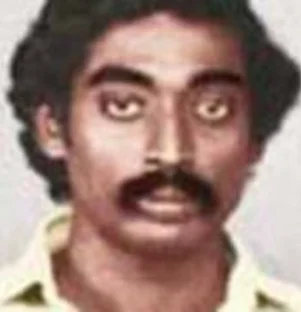
1954 - 1995
Summary
Name:
Gauri ShankarNickname:
Auto ShankarYears Active:
1988 - 1989Birth:
January 21, 1954Status:
ExecutedClass:
Serial KillerVictims:
6Method:
Strangulation / StabbingDeath:
April 27, 1995Nationality:
India1954 - 1995
Summary: Serial Killer
Name:
Gauri ShankarNickname:
Auto ShankarStatus:
ExecutedVictims:
6Method:
Strangulation / StabbingNationality:
IndiaBirth:
January 21, 1954Death:
April 27, 1995Years Active:
1988 - 1989Date Convicted:
May 31, 1991“Cinema made a devil of me.”
— Gauri Shankar
Auto Shankar was born on January 21, 1954, in a town in Tamil Nadu, India. His early life was spent in a modest environment. He grew up in a family with limited resources. The specific details about his family and childhood are not widely documented, but it is known that he faced challenges while growing up.
As he entered adulthood, Auto Shankar began working as an auto rickshaw driver. This job allowed him to be well-known in his community. His role as a driver gave him access to many areas in Chennai, particularly in Thiruvanmiyur, where he would later become infamous.
Shankar's life took a turn as he became involved in criminal activities. Reports indicate that he started engaging in various illegal acts, which eventually led to his notoriety. In his adult years, he also developed a reputation for being influenced by films, which he later claimed affected his actions.
The span of his criminal journey began in the late 1980s. It was during this time that a series of events would change his life forever. Despite his early struggles, his later actions would define him as one of India's most infamously known serial killers.
Auto Shankar's life ended when he was executed by hanging on April 27, 1995, at the Salem Central Prison. His story serves as a disturbing account of how a person can become lost in the world of crime and violence.
In late 1988, Auto Shankar kidnapped and murdered nine teenage girls in Thiruvanmiyur, Chennai. This series of abductions took place over a period of about six months. The victims were later identified as Lalitha, Sudalai, Sampath, Mohan, Govindaraj, and Ravi.
Initially, authorities believed that the girls might have been sold into prostitution. However, this theory changed when a schoolgirl named Subalakshmi reported an attempted abduction. This led detectives to suspect an auto rickshaw driver named Shankar. Investigators uncovered rumors about his involvement and discovered that he might have been cremating the bodies and disposing of the ashes in the Bay of Bengal.
The police arrested Auto Shankar, and he was later tried for the murders. Alongside Shankar, his accomplices Eldin and Shivaji were also sentenced to death. During the trial, Shankar blamed movies for his actions. However, shortly before his execution, he claimed that he had committed the crimes under the influence of powerful politicians who had raped these girls.
Auto Shankar was convicted and sentenced to death. He and two of his associates were hanged on April 27, 1995, at the Salem Central Prison. Other accomplices were sentenced to life imprisonment for their roles in the murders. The bodies of the victims were either burned or buried in residential areas. The trials and their outcomes received significant attention across the country.
