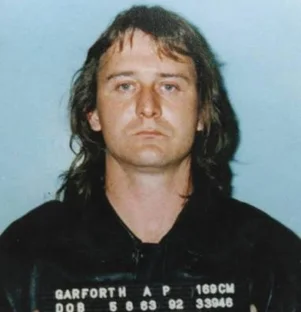
b: 1963
Summary
Name:
Andrew Peter GarforthYears Active:
1992Birth:
August 08, 1963Status:
ImprisonedClass:
MurdererVictims:
1Method:
DrowningNationality:
Australiab: 1963
Summary: Murderer
Name:
Andrew Peter GarforthStatus:
ImprisonedVictims:
1Method:
DrowningNationality:
AustraliaBirth:
August 08, 1963Years Active:
1992“I believed she could have possibly drowned or made it to the bank.”
— Andrew Peter Garforth
Andrew Peter Garforth, born in 1963, was an unemployed father of two young sons, ages one and three, with his wife, Denise. He had a prior criminal record limited to petty offenses, including breaking and entering, theft, and traffic violations. In mid-1992, after skipping bail on charges in Western Australia, Garforth relocated with his family to Bargo, a small town in the Southern Highlands region of New South Wales, settling roughly three kilometres from the Simpson family home.
On Wednesday, August 19, 1992, nine-year-old Ebony Jane Simpson travelled home from school by bus. Her mother normally met her at the bus stop, but arrangements were different that afternoon. Ebony’s older brother was expected to meet her after arriving on another bus, but his bus was delayed. Ebony began walking the short distance toward the family home by herself.
Garforth was near the route in his Mazda. According to the statement of facts and his later videotaped confession, he grabbed Ebony as she walked past the stopped vehicle. The abduction occurred close enough to the Simpson residence that she was still near home. Garforth forced her into the boot of the car and drove away from the residential area.
He drove Ebony to an isolated dam near the Wirrimbirra Sanctuary. At the location, he bound her hands and feet with wire taken from stereo equipment. He sexually assaulted her while she was restrained. He then weighted or filled her schoolbag with rocks before placing or securing it against her, further restricting her ability to remain above the water.
Garforth threw Ebony into the dam while she was still alive and left her there. Unable to free herself from the wire and additional weight, she drowned. The legal cause of death was asphyxiation caused by drowning. The murder occurred on the same afternoon as the abduction.
When Ebony did not arrive home, her family raised the alarm. Police quickly treated the disappearance as a likely abduction rather than a voluntary absence. Police officers, emergency-service personnel, firefighters and local volunteers began searching the Bargo area. Hundreds of people were eventually involved in the search.
Witness information focused attention on a man and vehicle seen near the bus stop or road where Ebony had disappeared. Garforth reportedly participated in or appeared around the community search while police were attempting to locate her. His involvement in the search was later reported as part of the investigation, although it did not prevent witnesses from connecting him and his vehicle to the area.
On August 21, two days after the abduction, searchers and police located Ebony’s body in the dam. Her hands and feet remained bound. The recovery confirmed that the missing-child investigation had become a murder case.
Police apprehended Garforth later that day and took him to Picton Police Station for questioning. During the interview, he admitted abducting Ebony, putting her in the boot of his car, driving her to the dam, binding and sexually assaulting her, and throwing her into the water. His admissions were recorded on video and later presented during the sentencing proceedings.
The manner in which Garforth described the killing became an important part of the prosecution’s sentencing case. When asked what he thought would happen after he placed a bound child in the dam, he first said that he did not know. He then said he believed she might drown or possibly reach the bank. Justice Newman found that these answers demonstrated indifference to Ebony’s fate and were inconsistent with any claim that her death was unintended.
Garforth was charged with murder. A crowd gathered when he appeared in court shortly after his arrest, reflecting the intense public reaction to the killing. The case received widespread attention throughout Australia, both because of Ebony’s age and because she had been abducted so close to her home while returning from school.
Garforth eventually pleaded guilty to murder. The exact date on which the court formally accepted the plea was not identified in the accessible materials, but it occurred before his sentencing hearing on July 9, 1993. The plea removed the need for a contested murder trial, although the court still received the detailed agreed facts, his recorded confession and information concerning his prior record and personal circumstances.
At sentencing, the prosecution relied on the abduction, sexual assault, restraint and deliberate drowning as aggravating features of the murder. Although Garforth had not received separate convictions for every act, the court was permitted to consider the complete circumstances in deciding the appropriate penalty for murder. This treatment later became one of the issues raised in his sentence appeal.
Justice Peter Newman found that Garforth intended to kill Ebony rather than merely cause injury. The judge placed the murder within the “worst category” of cases and concluded that a fixed prison term with a future parole date would not adequately reflect the crime, deter similar offending or protect the community.
On July 9, 1993, the Supreme Court of New South Wales sentenced Garforth to imprisonment for life. Justice Newman declined to set a non-parole period, meaning Garforth had no ordinary date on which he could apply for release. His prison papers were marked with the recommendation that he was never to be released.
The sentencing judge acknowledged Garforth’s guilty plea and relatively young age but found that those factors carried limited weight against the seriousness of the crime. The court also considered his prior criminal history, the lack of significant evidence supporting rehabilitation and the need to protect children and the wider community.
Garforth appealed the severity of the life sentence to the New South Wales Court of Criminal Appeal. His lawyers argued that the sentencing judge had improperly treated the abduction and sexual assault as aggravating circumstances when they could have been charged as separate offences. They also argued that his age and guilty plea justified a determinate sentence rather than imprisonment for the remainder of his natural life.
The appeal was heard on March 31, 1994. In a decision delivered on May 23, 1994, the Court of Criminal Appeal granted leave to appeal but dismissed the challenge. The court held that the abduction and sexual assault formed part of the circumstances of the murder and could properly be considered when assessing its seriousness.
The appellate judges accepted that life imprisonment was an exceptional punishment and that rehabilitation ordinarily remained an important sentencing consideration. They nevertheless concluded that a natural-life sentence was not limited only to offenders who could be proved entirely incapable of rehabilitation. In cases of extreme culpability, the need for punishment, deterrence and community protection could outweigh the prospect of eventual reform.
Garforth later sought special leave to appeal to the High Court of Australia. The application was refused, leaving the life sentence in place. The precise date of the High Court decision was not located in the accessible primary material, although the issue was discussed in the New South Wales Parliament during November 1994.
Garforth was placed in protective custody because prisoners convicted of sexual crimes against children faced a serious risk of attack. He was assaulted in custody before being sentenced. In October 1993, he was attacked again by a group of prisoners at Goulburn Correctional Centre and treated for cuts and bruising.
Reports later stated that he pursued compensation claims arising from alleged prison assaults. Those claims were reportedly withdrawn following public criticism. Detailed court or administrative decisions concerning the claims were not located, so they should be described only as reported claims rather than established compensation awards.
In 2015, the Serious Offenders Review Council recommended reducing Garforth’s security classification from A2 to a lower classification. The change concerned his management inside the correctional system and access to work or programmes; it would not have made him eligible for parole. Following public concern and intervention by the New South Wales corrections minister, the classification change was reversed.
A 2016 New South Wales parliamentary inquiry used the controversy surrounding Garforth as an example of public misunderstanding about prisoner classification. The inquiry explained that a lower internal security category did not alter the sentence or create a legal pathway to release. Garforth remained a natural-life prisoner regardless of the institution or security unit in which he was held.
The murder also contributed to the development of support and advocacy organisations for homicide victims’ relatives. Ebony’s parents, Christine and Peter Simpson, worked with Grace and Garry Lynch, the parents of murdered nurse Anita Cobby, in the establishment and development of the Homicide Victims’ Support Group. The organisation provided assistance to bereaved families and advocated for greater recognition of victims within the criminal justice system.
