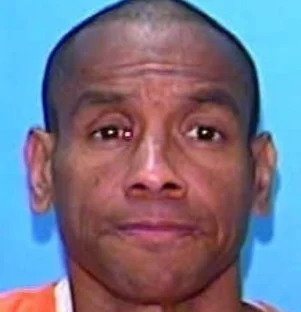
b: 1958
Summary
Name:
Albert HollandYears Active:
1990Birth:
March 24, 1958Status:
Awaiting ExecutionClass:
MurdererVictims:
1Method:
ShootingNationality:
USAb: 1958
Summary: Murderer
Name:
Albert HollandStatus:
Awaiting ExecutionVictims:
1Method:
ShootingNationality:
USABirth:
March 24, 1958Years Active:
1990Date Convicted:
August 19, 1991"From what I've seen in the evidence, Ray Charles could come in here and represent himself and Stevie Wonder, so I don't need too much legal training to do all that."
— Albert Holland
Albert Holland was born on March 24, 1958. In October 1979, while in federal custody, he suffered a serious brain injury after another inmate knocked him unconscious, leaving him with facial fractures, a slowly resolving concussion, and roughly three weeks of post-traumatic amnesia. In the early 1980s, he was arrested and charged with robbery in Washington, D.C.; his attorney at the time described him as homeless, disheveled, and largely unable to meaningfully communicate. Holland escaped from a psychiatric hospital on two occasions before eventually relocating to Florida.
On July 29, 1990, after smoking crack cocaine, Holland attacked a woman, Thelma Johnson, in Pompano Beach, Florida, beating her brutally and leaving her semi-conscious with severe head injuries. He fled the scene after a witness intervened. Police searched the area, and K-9 patrol officer Scott Winters of the Pompano Beach Police Department, 28, located Holland. Witnesses saw the two struggle; during the confrontation, Holland wrested Winters's service firearm away from him and shot him twice, in the groin and lower stomach. Winters called for backup at 7:25 p.m. and radioed again a minute later to report he had been shot; he died from his wounds at 8:30 p.m.
Holland was indicted and, after raising the issue of his competency (which the trial court resolved by finding him competent to stand trial), was tried in 1991 with an insanity defense. Disruptive behavior during that trial led to his removal from the courtroom. He was convicted and sentenced to death on August 19, 1991.
On direct appeal, the Florida Supreme Court reversed both the conviction and sentence in 1994, finding that the trial court had improperly admitted testimony from a psychiatrist, Dr. Abbey Strauss, who had examined Holland in jail without notice to his attorney — testimony obtained in violation of Holland's right to counsel and his right against self-incrimination.
At his second trial, Holland again raised an insanity defense and repeatedly asked to represent himself, at one point invoking his familiarity with the television legal drama "Matlock" as a basis for confidence in his own legal abilities. He was convicted a second time and resentenced to death on February 7, 1997; the Florida Supreme Court affirmed this conviction and sentence in Holland v. State, 773 So.2d 1065 (Fla. 2000).
Holland's case later became the basis for a significant U.S. Supreme Court ruling on federal habeas corpus procedure. His court-appointed attorney failed to file Holland's federal habeas corpus petition before the one-year deadline set by the Antiterrorism and Effective Death Penalty Act (AEDPA), despite Holland sending his attorney numerous letters urging him to do so and pointing out the relevant legal rules himself. In Holland v. Florida, 560 U.S. 631 (2010), the U.S. Supreme Court held, in an opinion authored by Justice Stephen Breyer, that the AEDPA filing deadline is subject to "equitable tolling" — meaning courts can excuse a late filing — in cases involving sufficiently egregious attorney misconduct, and returned Holland's case for further proceedings on that basis.
In subsequent federal habeas litigation, a federal district court found that a Broward County judge had violated Holland's constitutional right to represent himself (a "Faretta" violation, referring to the Supreme Court case establishing that right) during his second trial, and ordered a new trial. The State of Florida appealed this ruling, and in 2023, the U.S. Court of Appeals for the Eleventh Circuit reversed the district court, reinstating Holland's 1997 conviction and death sentence. Holland's death sentence stood reinstated, and he remained on Florida's death row.
